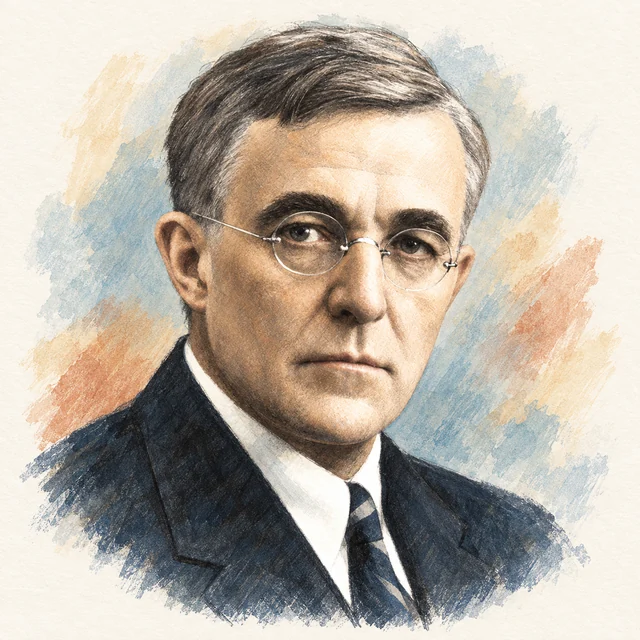
A life in context
The person behind the prize
Langmuir graduated as a metallurgical engineer from Columbia in 1903 and earned his doctorate with Walther Nernst in Göttingen in 1906. After teaching at Stevens Institute of Technology, he joined General Electric’s research laboratory in Schenectady in 1909. Questions arising from vacuum equipment and lamp filaments led him to investigate what atoms and molecules do at surfaces. He studied adsorbed layers on solids, films on water and how surface organization affects chemical reactions. His idealized model of adsorption treated a surface as a limited set of molecular binding sites. He received the full 1932 Chemistry Prize for discoveries and investigations in surface chemistry. The field included earlier researchers and colleagues, rather than a single isolated inventor. Katharine Burr Blodgett worked with him at GE and later developed multilayer film deposition in 1935, after this award. Langmuir’s wider work also covered electrical discharges and chemical bonding.
The contribution
Langmuir received the full Chemistry Prize for discoveries and investigations in surface chemistry. His work made adsorbed monolayers and molecular films objects of quantitative study, linking surface occupancy with physical and chemical behaviour.
The idea in plain language
A surface is where substances in different phases meet, such as a solid exposed to a gas or water in contact with air. What happens there can differ from what happens in the bulk material. Langmuir’s work on vacuum systems and lamp filaments led him to study particles retained at surfaces. Under suitable conditions, a stable adsorbed layer can be only one atom or molecule thick. Measuring the amount retained and the area available helped test this molecular picture.
Read the full award story ↗

