01 · The discovery
The idea, in everyday language
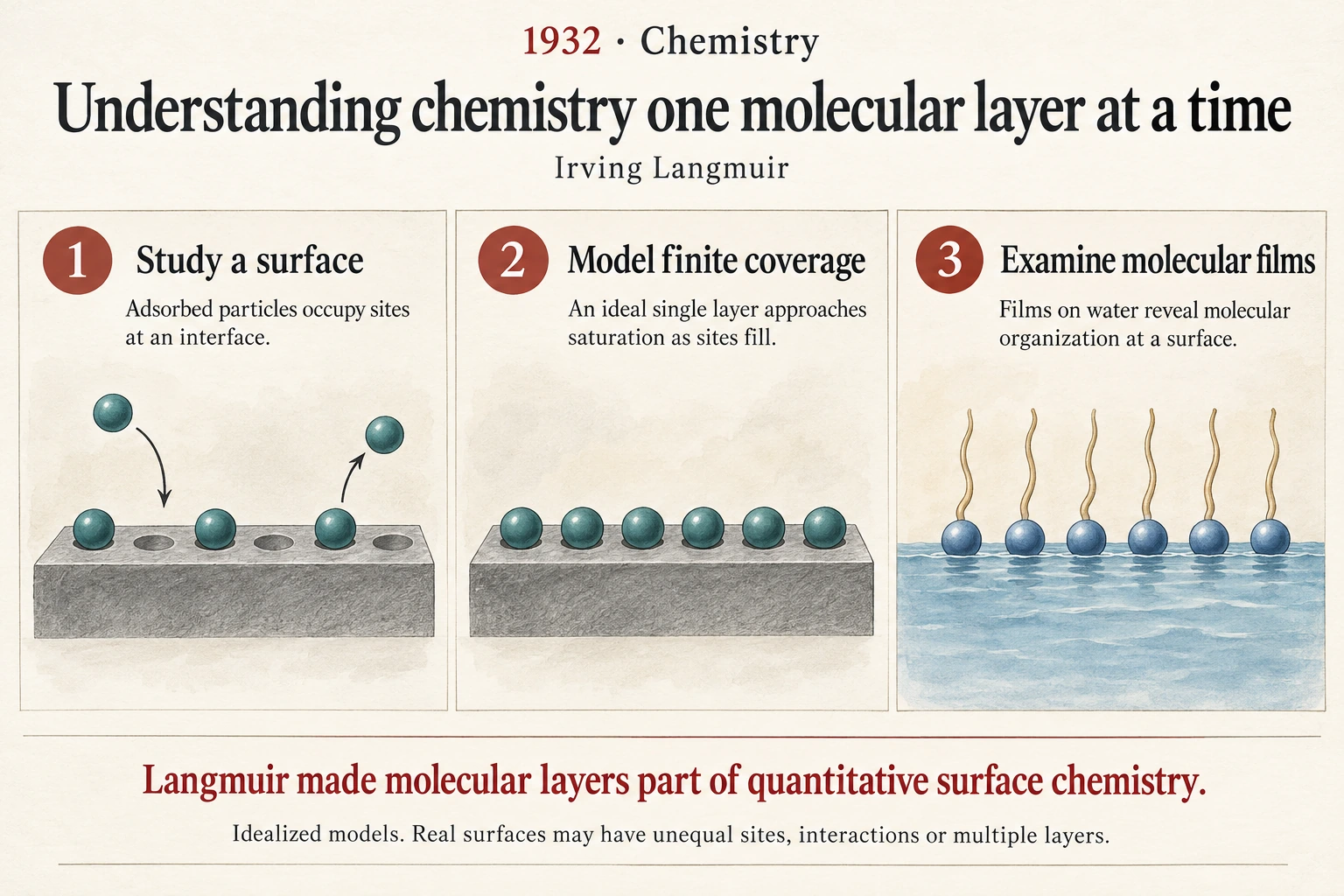
A surface is where substances in different phases meet, such as a solid exposed to a gas or water in contact with air. What happens there can differ from what happens in the bulk material. Langmuir’s work on vacuum systems and lamp filaments led him to study particles retained at surfaces. Under suitable conditions, a stable adsorbed layer can be only one atom or molecule thick. Measuring the amount retained and the area available helped test this molecular picture.
In an idealized adsorption model, the surface has a finite number of equivalent sites, each holding at most one adsorbed particle. Occupancy reflects a balance between arrival and departure, so increasing gas pressure can increase coverage toward saturation. Langmuir also studied films spread on water, where molecular arrangement and lateral forces could be examined. This was a wider programme than one equation. Katharine Burr Blodgett’s later work extended film transfer to multilayers in 1935; it should not disappear into Langmuir’s sole 1932 award.
Why it matters
Surface chemistry became a quantitative way to investigate adsorption, molecular films and catalysis. It connected industrial questions with fundamental measurements of atoms and molecules at interfaces. Later coating and materials technologies drew on a broad field of subsequent work, rather than being finished products of the 1932 prize.