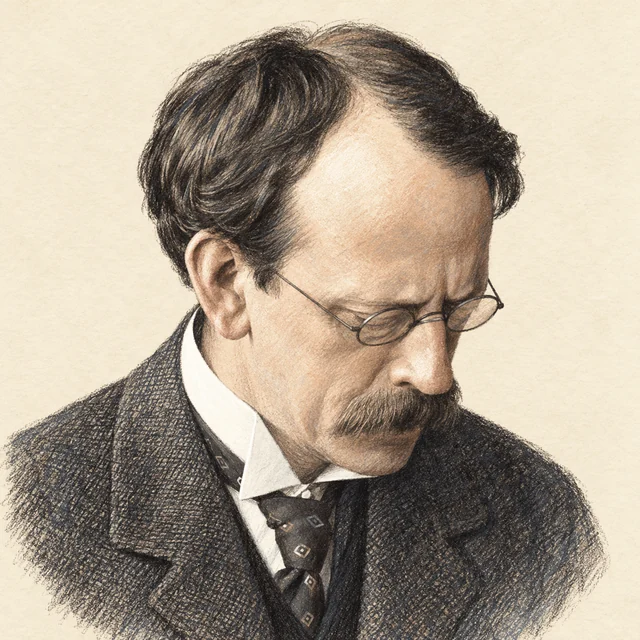
A life in context
The person behind the prize
Joseph John Thomson entered Owens College in Manchester in 1870 and Trinity College, Cambridge, in 1876. Mathematical training informed a career increasingly concerned with experiments on electricity and matter. He became a Trinity fellow in 1880 and succeeded Lord Rayleigh as Cavendish Professor in 1884. The laboratory became a centre where students and collaborators investigated the passage of electricity through gases. Cathode rays were a crucial puzzle: were they waves, or streams of material particles? In 1897 Thomson used their deflection in electric and magnetic fields to determine the ratio of electric charge to mass. The very large ratio, and its consistency with different materials, supported a common, extremely light, negatively charged constituent of matter, which he called a corpuscle and is now called the electron. This was evidence for structure inside the atom, rather than a measurement of every property of the electron at once. Determining the charge separately required further work by Thomson and others; Millikan’s later measurements belong to a subsequent chapter. Thomson’s full 1906 Physics Prize recognised the broader theoretical and experimental investigation of conduction through gases. His 1903 book Conduction of Electricity through Gases brought this programme together. His proposed atomic model placed electrons within distributed positive charge; the later nuclear model associated with Rutherford should not be projected onto his 1897 experiment. Thomson also studied positive rays and helped develop methods of identifying different atomic masses, work extended by Francis Aston. He was knighted in 1908, served as president of the Royal Society from 1916 to 1920 and became Master of Trinity in 1918. He married Rose Elisabeth Paget in 1890; their son George Paget Thomson received a separate Physics Prize in 1937. Thomson died in Cambridge in 1940. His influence includes both the electron evidence and the experimental school built around the Cavendish Laboratory.
The contribution
Thomson received the full Physics Prize for theoretical and experimental investigations of the conduction of electricity by gases. Cathode-ray measurements established evidence for the electron as a common constituent of matter.
The idea in plain language
In a tube containing gas at reduced pressure, an electrical discharge can produce cathode rays. Thomson studied how these rays behaved in electric and magnetic fields. Their deflection allowed him to infer a ratio of charge to mass far larger than that of familiar charged atoms.
Read the full award story ↗

