A life in context
The person behind the prize
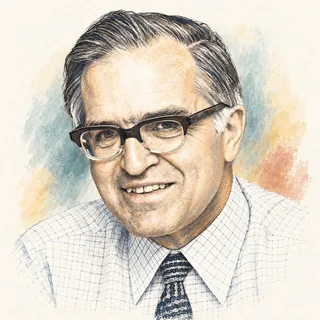
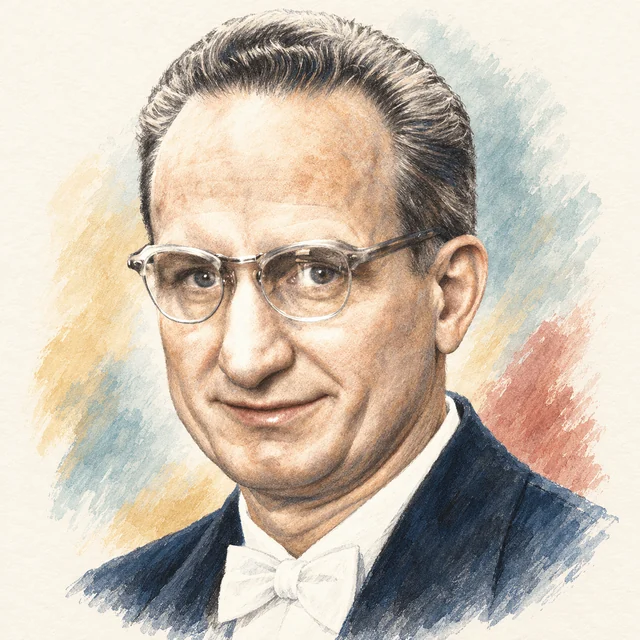
Rainwater was born in Idaho and grew up in California after his father died during the 1918 influenza epidemic. Strong school results led to Caltech, where he graduated in physics in 1939. He then began graduate work at Columbia and remained there throughout his career. Wartime neutron-spectroscopy research delayed publication of his thesis until declassification allowed the doctorate in 1946. He helped develop Columbia’s synchrocyclotron and studied nuclear properties through several experimental methods. In late 1949, a discussion of large nuclear quadrupole moments suggested how nucleon motion could favour a deformed nucleus. His 1950 proposal joined single-particle ideas with collective shape changes. Sharing an office and discussions with Aage Bohr helped connect this insight with the later Copenhagen programme.
The contribution
Rainwater independently proposed a connection between nucleon motion and nuclear deformation. The resulting theory, developed and tested by Bohr, Mottelson and others, brought him one third of the Physics Prize.
The idea in plain language
The shell model describes protons and neutrons through quantum states, while a liquid-drop picture captures collective properties of the nucleus. Each highlights part of the problem. Large nuclear quadrupole moments and patterns in nuclear spectra called for an account that could connect individual motion with a non-spherical distribution of the whole nucleus. Rainwater’s 1950 proposal and Bohr’s independent ideas showed how these features could be related: the arrangement of nucleons influences the collective shape, and that shape changes the states available to the nucleons.
Read the full award story ↗