01 · The discovery
The idea, in everyday language
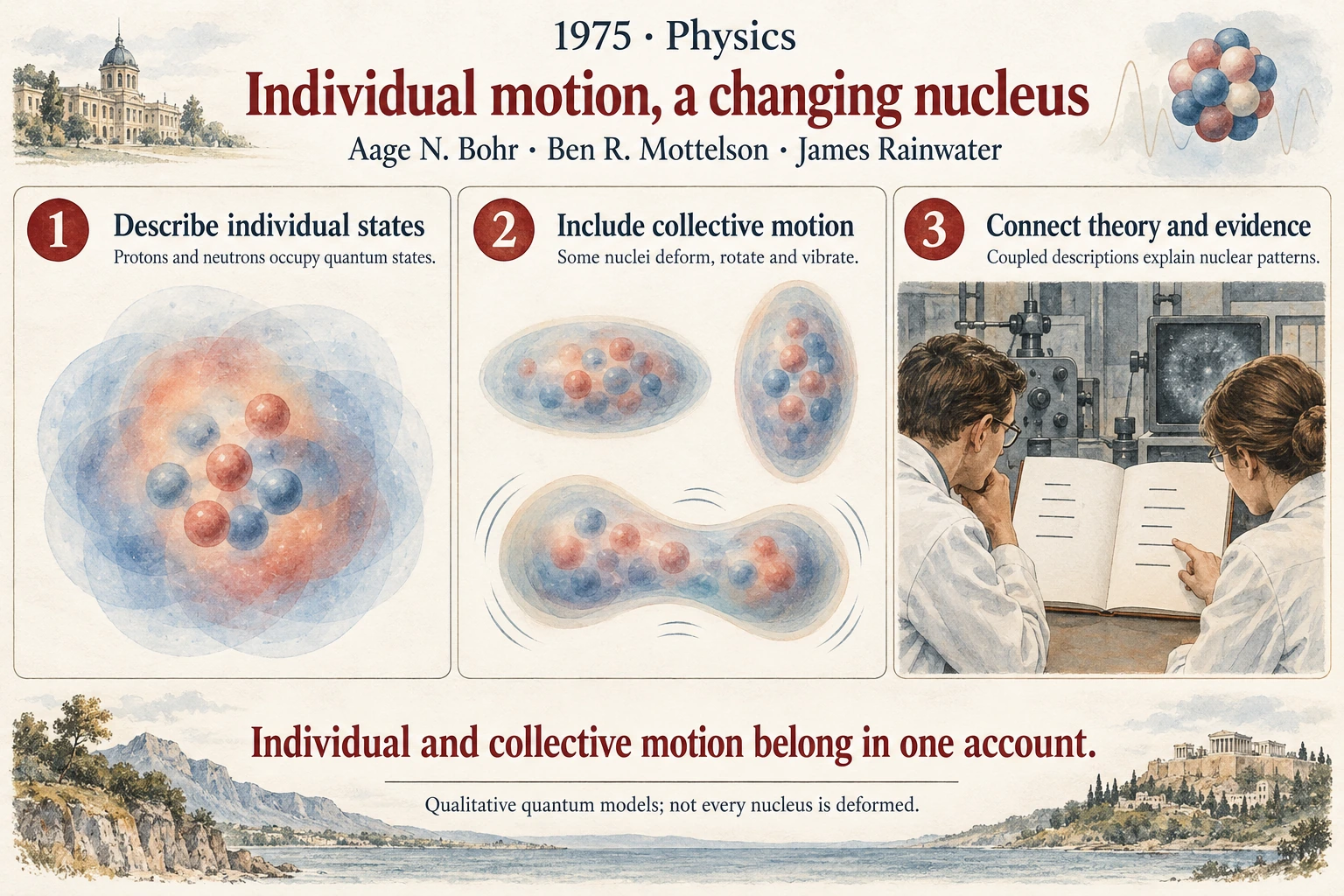
The shell model describes protons and neutrons through quantum states, while a liquid-drop picture captures collective properties of the nucleus. Each highlights part of the problem. Large nuclear quadrupole moments and patterns in nuclear spectra called for an account that could connect individual motion with a non-spherical distribution of the whole nucleus. Rainwater’s 1950 proposal and Bohr’s independent ideas showed how these features could be related: the arrangement of nucleons influences the collective shape, and that shape changes the states available to the nucleons.
Bohr and Mottelson developed and tested the connection, notably through work in 1952–1953. Rotational and vibrational patterns could then be interpreted alongside single-particle behaviour. The resulting nuclear-structure theory is a quantum description, not a picture of miniature planets physically rubbing a shell. All three laureates received equal shares. Aage Bohr’s contribution is distinct from the earlier atomic work of his father Niels, and the model does not require every nucleus to have the same deformation.
Why it matters
The connection made nuclear spectra and shapes part of a more coherent description. It helped researchers interpret rotations, vibrations and transitions in many nuclei while retaining the value of single-particle ideas. Nuclear structure became a question of how several useful descriptions fit together.