01 · The discovery
The idea, in everyday language
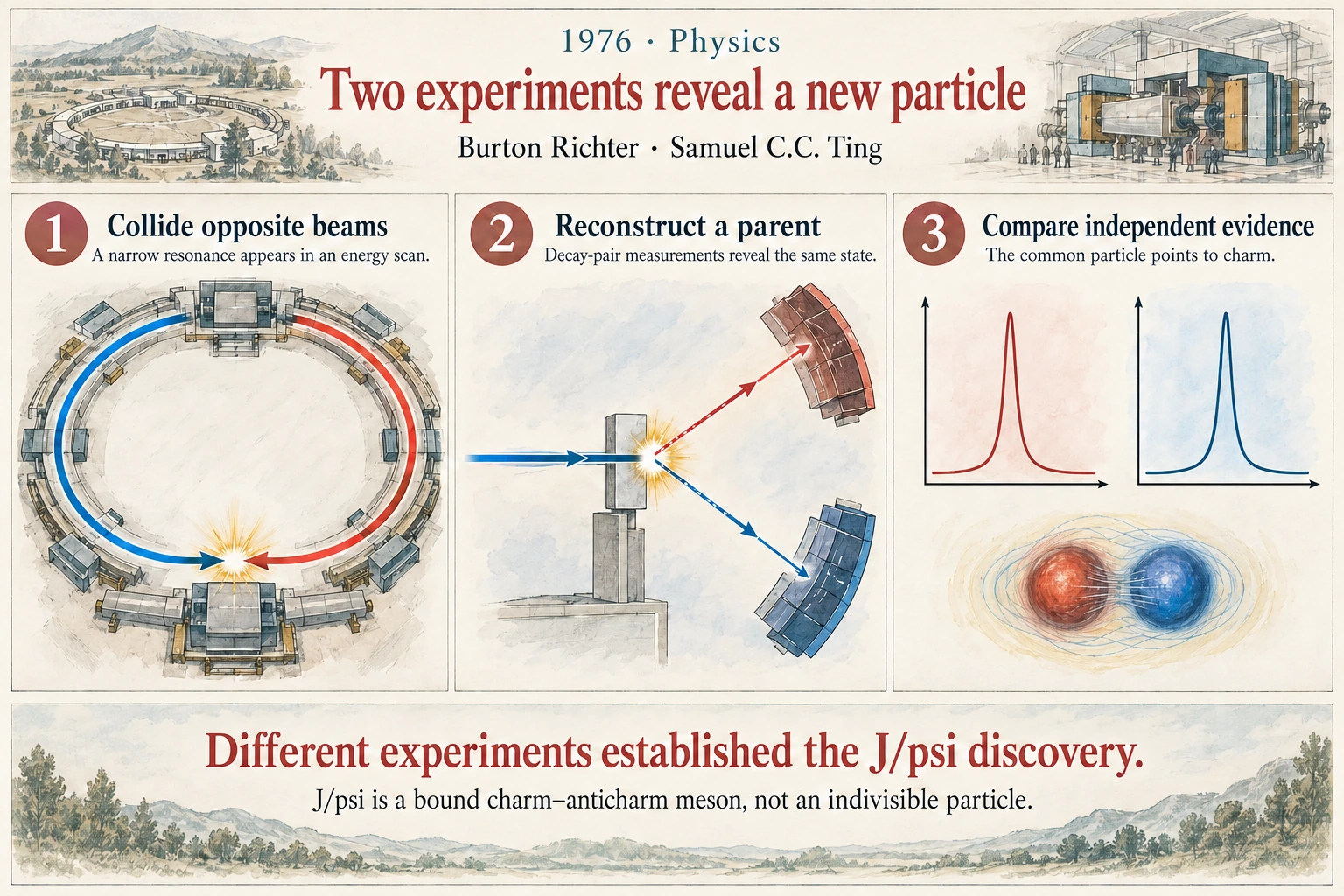
At SLAC, Richter’s collaboration varied the energy of electrons and positrons colliding in the SPEAR storage ring. At a particular energy, particle production rose sharply: a narrow resonance signalled an unexpectedly long-lived state. At Brookhaven, Ting’s team directed protons into a stationary beryllium target and selected rare electron–positron pairs from a large background. Their measured energies and momenta allowed the team to infer the mass of a parent particle. These were independent experiments with different methods, not two stages of one apparatus.
The two teams compared their findings and announced the discovery on 11 November 1974. What Richter called psi and Ting called J were the same state. Its properties helped establish the charm quark and changed the interpretation of particle families. In modern language, J/psi is a meson containing a charm quark and its antiquark, bound by the strong interaction. The older prize motivation’s description as an elementary particle belongs to the historical vocabulary of the announcement. Detecting a composite state supplied evidence about its constituents; the experiments did not photograph isolated charm quarks.
Why it matters
The discovery opened a new programme of studying charmonium and strengthened the quark account of matter. It illustrates why sharply resolved measurements and independent experimental approaches can change a theoretical picture. The 1976 prize gave equal shares to Richter and Ting, recognising their collaborations’ pioneering discoveries.