A life in context
The person behind the prize
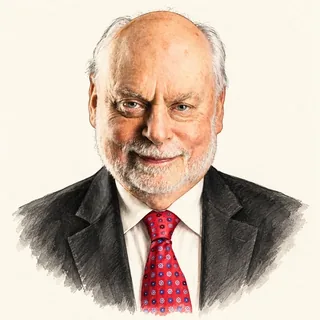
Sauvage completed his doctorate in Strasbourg in 1971 under Jean-Marie Lehn. His career at the French national research centre CNRS and the University of Strasbourg explored ways to organise molecules into unfamiliar structures. Instead of treating chemistry only as a way to connect atoms through conventional bonds, he investigated how whole molecular components could be linked while retaining freedom to move.
The contribution
In 1983 his team used a copper ion to guide the assembly of two interlocked molecular rings, a catenane. The mechanical link held the rings together without a covalent bond between them. Later work developed controlled relative motion in such structures.
The idea in plain language
A tiny object is not automatically a machine. Its parts must move relative to one another in a useful, controllable way. Sauvage used a copper ion to help assemble two molecular rings that were linked like chain links. Each ring retained its own chemical framework; the rings stayed together because of their interlocking shape. Stoddart developed a ring threaded on a molecular axle. The ring could move between positions, giving chemists a route to shuttles and switches.
Read the full award story ↗