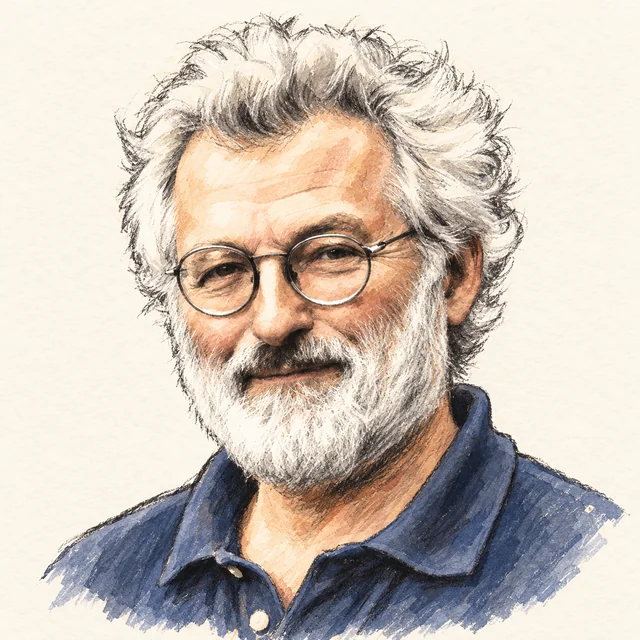
A life in context
The person behind the prize
Sulston brought a chemist’s training and a talent for close observation to developmental biology. Working with C. elegans in Cambridge, he spent long periods at the microscope following individual cells as the animal grew. Later, he helped lead genome-sequencing work and directed the Sanger Centre until 2000. The achievement recognised in this prize arose from the earlier, painstaking effort to connect each developing cell with its descendants and eventual fate.
The contribution
Sulston mapped cell lineages and showed that particular cells die reproducibly during normal worm development. His 1976 work described part of the developing nervous system and helped make these deaths experimentally accessible. He also identified mutations affecting the process, including nuc-1, which is needed to degrade DNA from dead cells. Mapping what normally happens made it possible to ask which genes change the pattern, rather than treating cell death as random damage.
The idea in plain language
Building an animal involves more than making new cells. Cells divide, become specialised and, in some cases, are deliberately eliminated through a regulated biological process. Brenner established the small roundworm C. elegans as a model in which researchers could alter genes and observe the consequences. Its transparency made individual cells visible under a microscope.
Read the full award story ↗