01 · The discovery
The idea, in everyday language
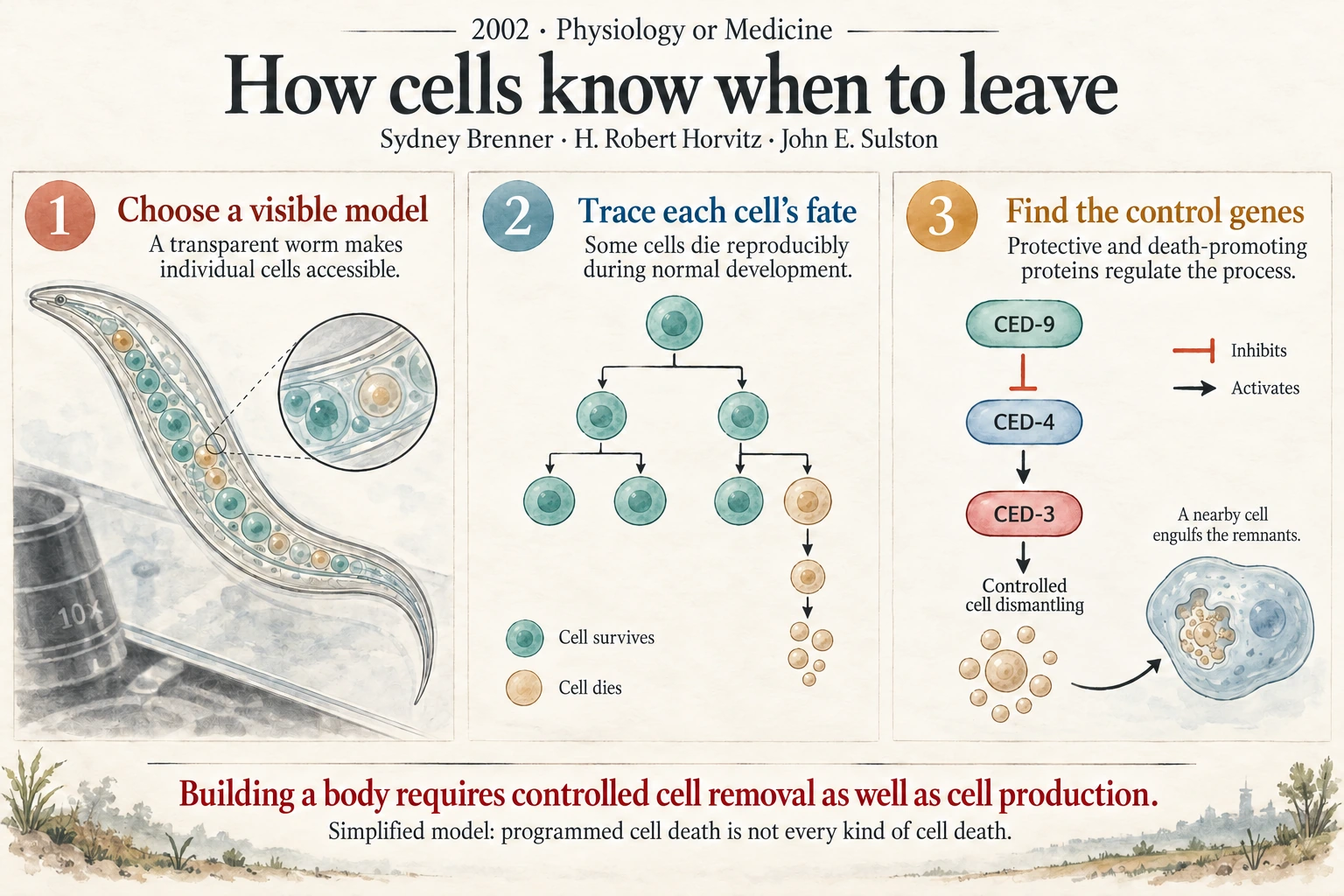
Building an animal involves more than making new cells. Cells divide, become specialised and, in some cases, are deliberately eliminated through a regulated biological process. Brenner established the small roundworm C. elegans as a model in which researchers could alter genes and observe the consequences. Its transparency made individual cells visible under a microscope.
Sulston traced cell lineages and found that particular cells die at reproducible stages of normal development. Horvitz then identified genes that control this programme: some are needed to execute cell death, while others protect cells by restraining the pathway. Finding related machinery in humans showed that the worm could reveal principles extending far beyond one small species.
Why it matters
The work connected genetic experiments with the life histories of individual cells. It established an experimental route to understanding programmed cell death and helped identify conserved molecular pathways. These pathways matter in development and tissue maintenance, and their disruption can contribute to disease. The discoveries provided foundations for later medical research rather than a single treatment for every disorder involving cell loss.