c.curionodeThe Nobel Archive

2001 · Physiology or Medicine

The controls that keep cell division in order

Genes, cyclins and protein kinases explain how cells coordinate DNA copying and division.

cell cyclecyclinsCDKscheckpoints
2001Physiology or Medicine

Visual guide

The prize, pictured

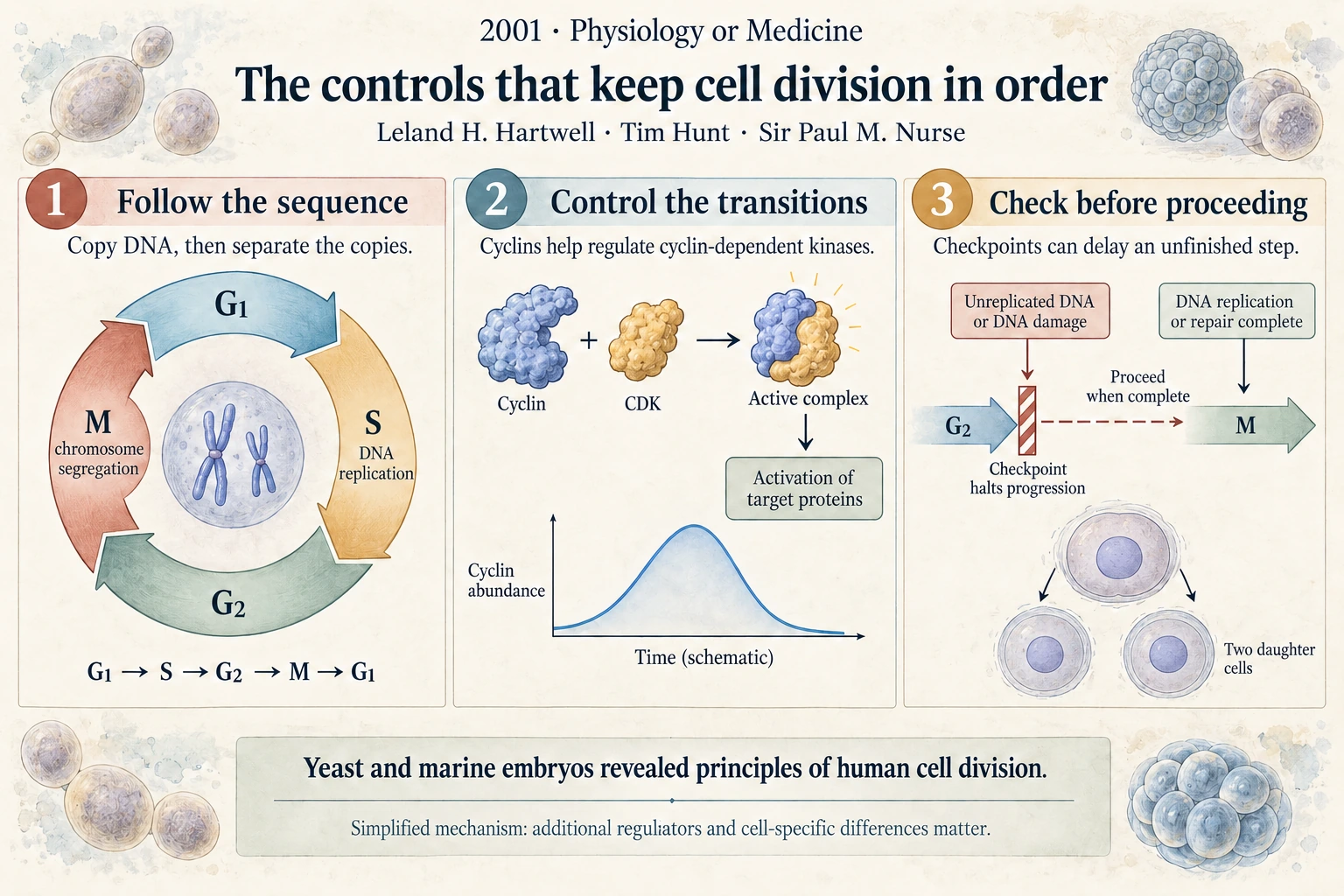
Infographic explaining The controls that keep cell division in order
Original AI-generated infographic. A conceptual overview; the explanations and sources below provide context.
Read the poster text

Yeast and marine embryos revealed principles of human cell division.

  1. Follow the sequence

    Copy DNA, then separate the copies.

  2. Control the transitions

    Cyclins help regulate cyclin-dependent kinases.

  3. Check before proceeding

    Checkpoints can delay an unfinished step.

Simplified mechanism: additional regulators and cell-specific differences matter.

01 · The discovery

The idea, in everyday language

A dividing cell must copy its DNA and distribute the copies in an orderly sequence. The cell cycle is often described as G1, S, G2 and M: DNA is replicated in S, while chromosomes are segregated during mitosis in M. Hartwell used budding-yeast mutants to identify genes needed at particular stages and developed the idea of checkpoints that can delay progression when something is incomplete.

Nurse identified a central regulator in fission yeast and its human counterpart, revealing conserved cyclin-dependent kinases. Hunt discovered cyclins, proteins whose abundance rises and then drops during successive divisions. Cyclins and kinases work together, with other controls, to coordinate transitions. Studies of yeast and sea-urchin eggs thus exposed machinery relevant to the division of human cells.

Why it matters

The discoveries connected genetics, protein chemistry and cell biology into an account of cell-cycle control. They helped explain how diverse organisms coordinate growth, genome copying and division. Because failures of this regulation can contribute to cancer, the work also supplied a foundation for later disease research and treatments directed at parts of the control machinery.
02 · The people

Who brought the idea to life?

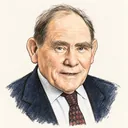
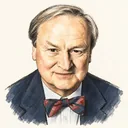
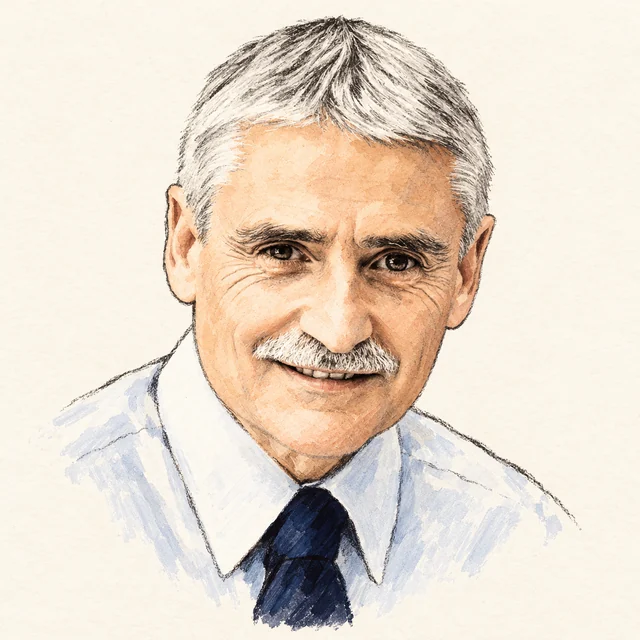
Illustrated portrait of Leland H. Hartwell

Leland H. Hartwell

Prize share · 1/3

Hartwell identified genes whose disruption halted yeast cells at particular stages of division. These cell-division-cycle genes helped reveal the machinery that orders the process, including a crucial control point known as Start. He also developed the checkpoint concept: cells can delay later steps when earlier events, such as DNA replication or repair, have not been completed properly. Checkpoints regulate progression; they do not guarantee that every error is prevented.

Read the biography ↗
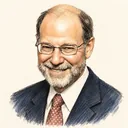
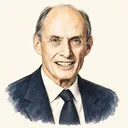
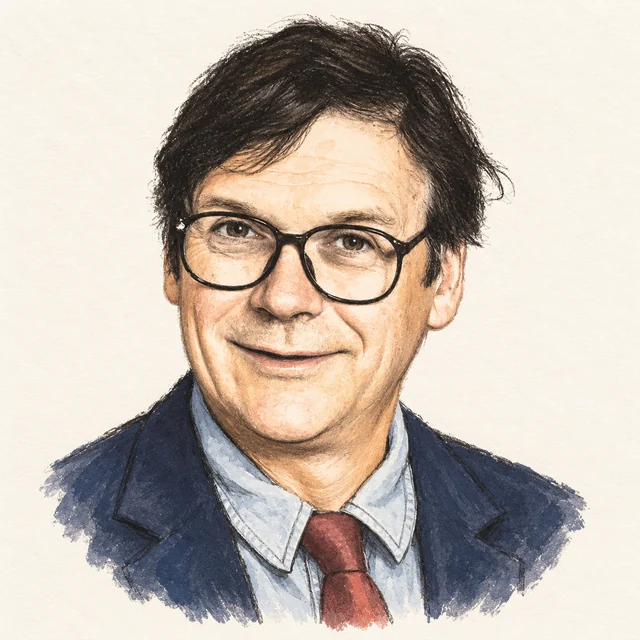
Illustrated portrait of Tim Hunt

Tim Hunt

Prize share · 1/3

In experiments on sea-urchin eggs in 1982, Hunt discovered proteins that accumulated and were then rapidly destroyed during successive cell divisions. He called them cyclins. Cyclins bind to and help regulate cyclin-dependent kinases, linking changes in protein abundance to cell-cycle control. Their periodic destruction helps make transitions orderly. Cyclin concentration is an important part of the mechanism, alongside phosphorylation and other regulatory processes.

Read the biography ↗
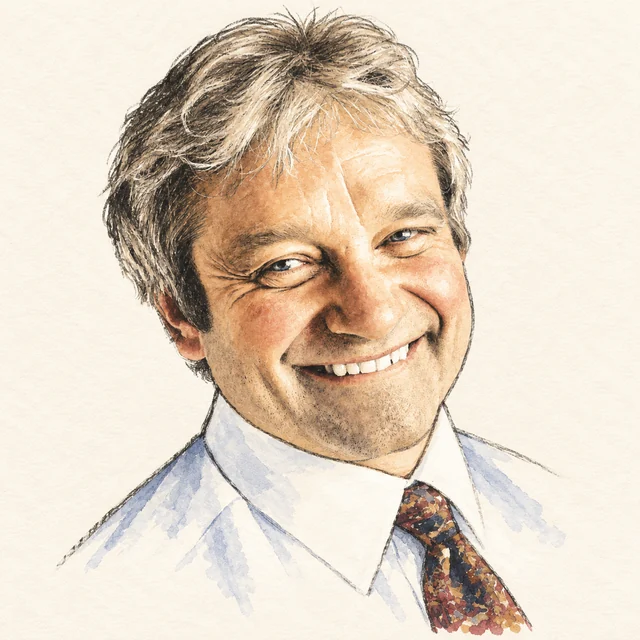
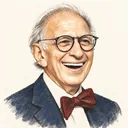
Illustrated portrait of Sir Paul M. Nurse

Sir Paul M. Nurse

Prize share · 1/3

Nurse identified the fission-yeast gene cdc2 as a central regulator of the cell cycle and later isolated its human counterpart. The encoded protein belongs to the cyclin-dependent kinase family. These enzymes modify other proteins by adding phosphate groups, helping coordinate transitions through the cycle. Finding related control machinery in yeast and humans showed that basic principles of division are conserved across very different organisms.

Read the biography ↗

03 · Years in the making

The path here

  1. 1970s

    Yeast genetics revealed genes central to cell-cycle control.

  2. 1982

    Hunt discovered cyclins in experiments on sea-urchin eggs.

  3. 1987

    Nurse isolated the human counterpart of the yeast cdc2 gene.

04 · Read further

From the original sources

Original explanations by Curionode, based on the official records below. Biographical details and affiliations refer to the award year.

  1. Official announcement nobelprize.org

More in Physiology or Medicine

Browse this subject ↗