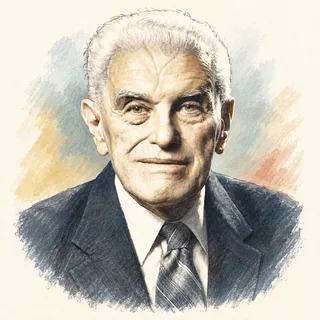
A life in context
The person behind the prize
Nash studied at Carnegie Tech before doctoral work in mathematics at Princeton. His 1950 dissertation introduced a powerful approach to strategic interaction; later work at MIT also made major contributions to geometry. Serious mental illness interrupted his career for many years, a history he discussed openly. At the 1994 award he was associated with Princeton, where the game-theory work had begun.
The contribution
Nash defined an equilibrium in which no player can improve their own payoff by changing strategy alone while the others keep theirs fixed. For finite games, allowing mixed strategies gives an existence result even when no pure-strategy equilibrium exists. This supplied a general framework beyond two-person zero-sum games. An equilibrium need not be unique, fair or best for the group, and the theorem is not a guarantee of actual behaviour.
The idea in plain language
A firm setting a price, a negotiator making an offer or a policymaker announcing a rule may need to anticipate others’ responses. Nash supplied a general equilibrium concept: with everyone else’s strategies fixed, no player can improve their own payoff by changing alone. For games with finite players and finite strategy sets, mixed strategies allow an existence theorem beyond two-person zero-sum situations.
Read the full award story ↗