A life in context
The person behind the prize
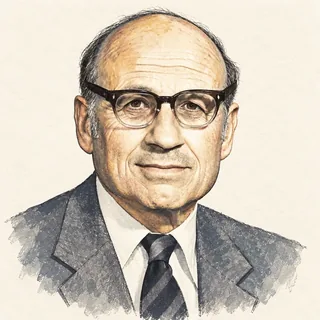
Pople grew up in an English seaside town and developed an early talent for mathematics. He studied and began his research career at Cambridge before moving into work on molecular theory and computing. He later worked at Carnegie Mellon and Northwestern. He wanted quantum-chemical methods to be reliable, affordable in computing time and usable by chemists who were not specialists in the underlying mathematics.
The contribution
Pople developed systematic computational methods for molecular electronic structure and helped make them widely available through the Gaussian program, first released in 1970. His work combined approximations, basis sets and comparisons with experiment into practical procedures. It complemented Kohn’s density-based framework; the two contributions were distinct routes toward useful quantum-chemical calculations.
The idea in plain language
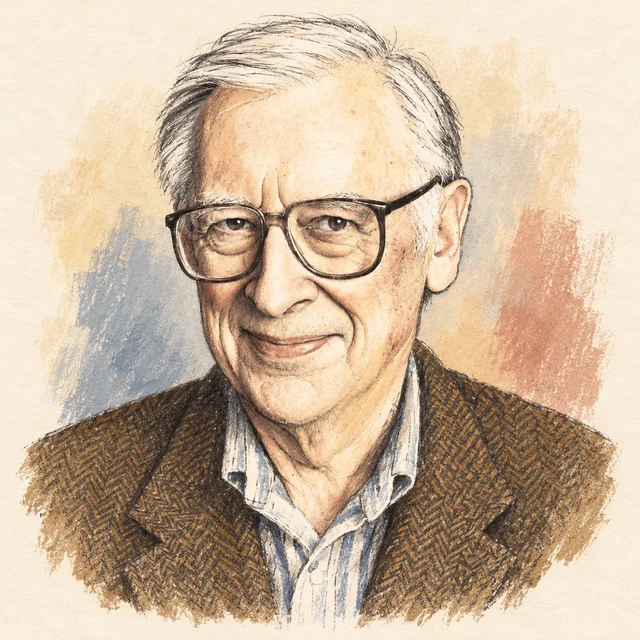
Quantum mechanics describes electrons and nuclei, but applying its equations to a molecule rapidly becomes a formidable task. Kohn’s density-functional framework made the ground-state electron density the central variable. Foundations developed with collaborators in 1964 and 1965 opened a more tractable route to calculating energies and molecular structure.
Read the full award story ↗