c.curionodeThe Nobel Archive

1998 · Chemistry

Making molecules calculable

Kohn and Pople developed distinct foundations and methods that made quantum chemistry useful in practice.

density-functional theoryquantum chemistryGaussianelectronic structure
1998Chemistry

Visual guide

The prize, pictured

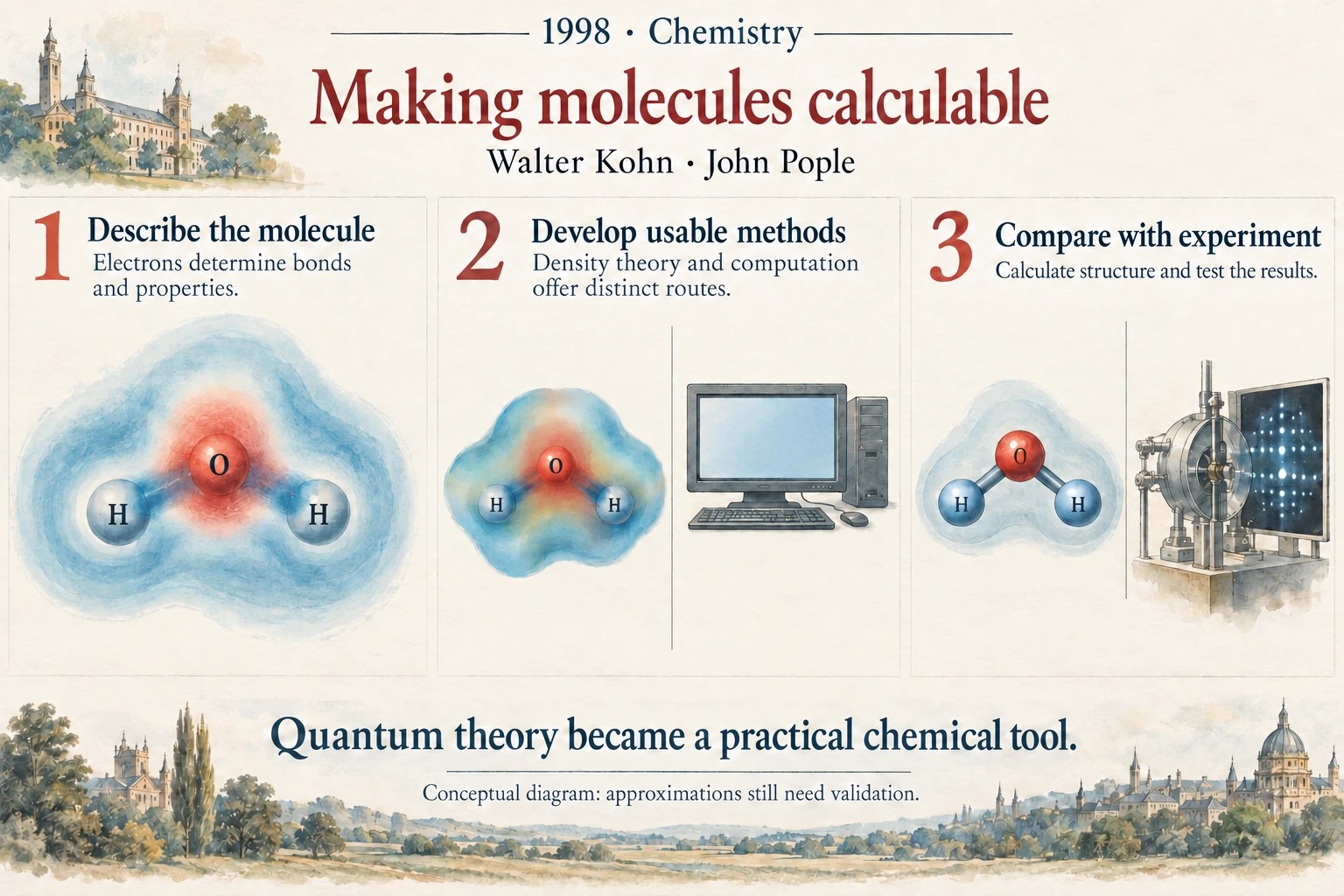
Infographic explaining Making molecules calculable
Original AI-generated infographic. A conceptual overview; the explanations and sources below provide context.
Read the poster text

Quantum theory became a practical chemical tool.

  1. Describe the molecule

    Electrons determine bonds and properties.

  2. Develop usable methods

    Density theory and computation offer distinct routes.

  3. Compare with experiment

    Calculate structure and test the results.

Conceptual diagram: approximations still need validation.

01 · The discovery

The idea, in everyday language

Quantum mechanics describes electrons and nuclei, but applying its equations to a molecule rapidly becomes a formidable task. Kohn’s density-functional framework made the ground-state electron density the central variable. Foundations developed with collaborators in 1964 and 1965 opened a more tractable route to calculating energies and molecular structure.

Pople developed systematic quantum-chemical methods and accessible software, including Gaussian, first released in 1970. He emphasized assessing accuracy, choosing workable approximations and making calculations usable by other chemists. Together, these distinct contributions helped turn quantum theory into practical studies of molecular geometry, properties and reactions.

Why it matters

Computational chemistry became a widely used partner to experiment, helping researchers interpret measurements and explore candidate structures and reaction pathways. The award recognized both theoretical foundations and usable methods, built upon by many collaborators and later researchers.
02 · The people

Who brought the idea to life?

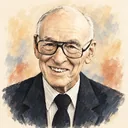
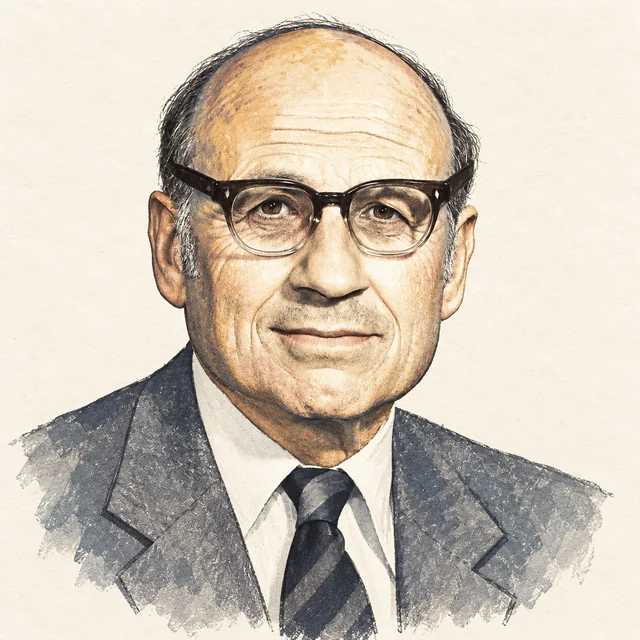
Illustrated portrait of Walter Kohn

Walter Kohn

Prize share · 1/2

Kohn established the foundations of density-functional theory with collaborators in 1964 and 1965. The ground-state electron density became the central variable for determining a system’s energy and properties. This replaced an impractically complex description with a more tractable framework. Practical calculations still require approximations, especially for exchange and correlation; Kohn did not supply an exact universal computational shortcut.

Read the biography ↗
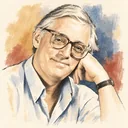
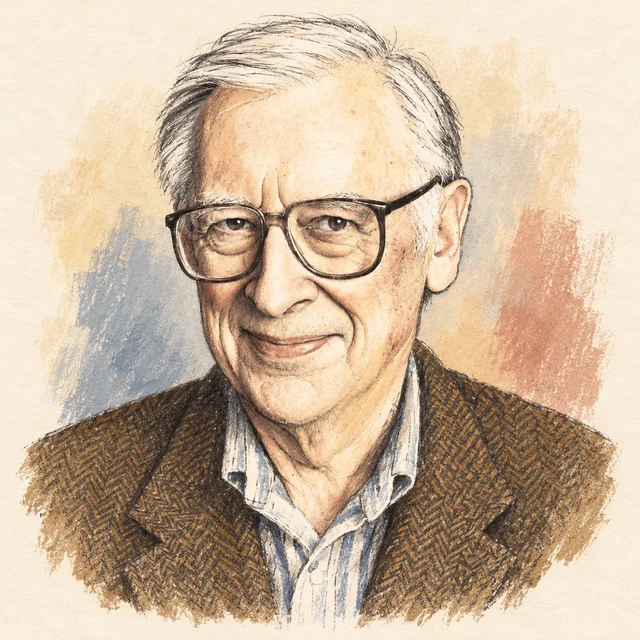
Illustrated portrait of John Pople

John Pople

Prize share · 1/2

Pople developed systematic computational methods for molecular electronic structure and helped make them widely available through the Gaussian program, first released in 1970. His work combined approximations, basis sets and comparisons with experiment into practical procedures. It complemented Kohn’s density-based framework; the two contributions were distinct routes toward useful quantum-chemical calculations.

Read the biography ↗

03 · Years in the making

The path here

  1. 1964

    Kohn and Hohenberg established density-functional foundations.

  2. 1965

    Kohn and Sham developed a practical equation framework.

  3. 1970

    The first Gaussian program was released.

  4. 1998

    The prize recognized Kohn’s theory and Pople’s computational methods.

04 · Read further

From the original sources

Original explanations by Curionode, based on the official records below. Biographical details and affiliations refer to the award year.

  1. Official announcement nobelprize.org

More in Chemistry

Browse this subject ↗