01 · The discovery
The idea, in everyday language
Knowing the ingredients and products does not reveal the route between them. The decisive rearrangements in a reaction can occur on the timescale of atomic vibrations, far faster than ordinary instruments resolve. Chemical kinetics could describe overall rates while leaving the fleeting steps around a transition state inaccessible to direct time-resolved investigation.
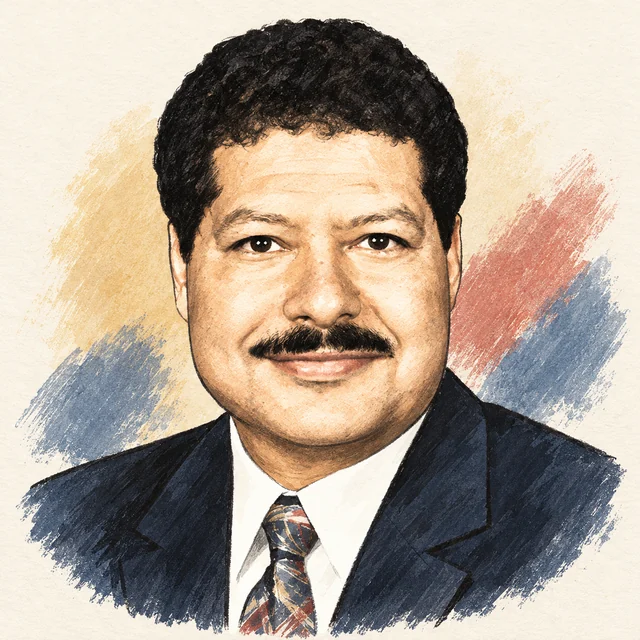
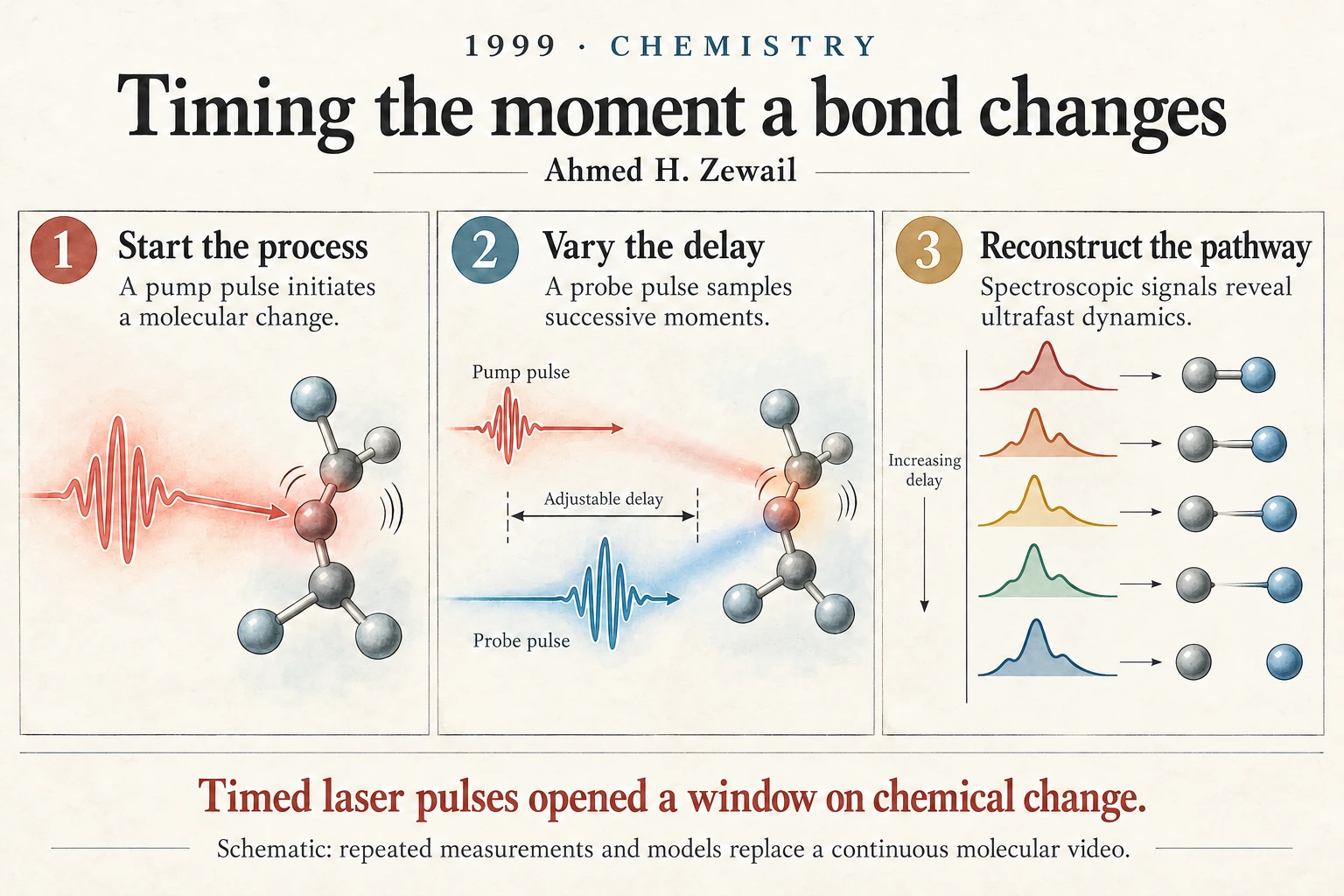
Zewail’s pump–probe method uses one pulse to initiate a process and another to interrogate it after a controlled delay. Repeating this at different delays reconstructs changes from spectroscopic signals. Experiments in the late 1980s resolved bond breaking and short-lived configurations, allowing researchers to distinguish possible reaction pathways rather than infer everything from final products.
Why it matters
Femtochemistry made reaction dynamics experimentally accessible. It helped investigate bond breaking, intermediates, energy flow and light-induced structural changes across gases, liquids and other systems. Understanding mechanisms can inform control of reactions, but practical improvements depend on the particular chemical system and experimental conditions.