01 · The discovery
The idea, in everyday language
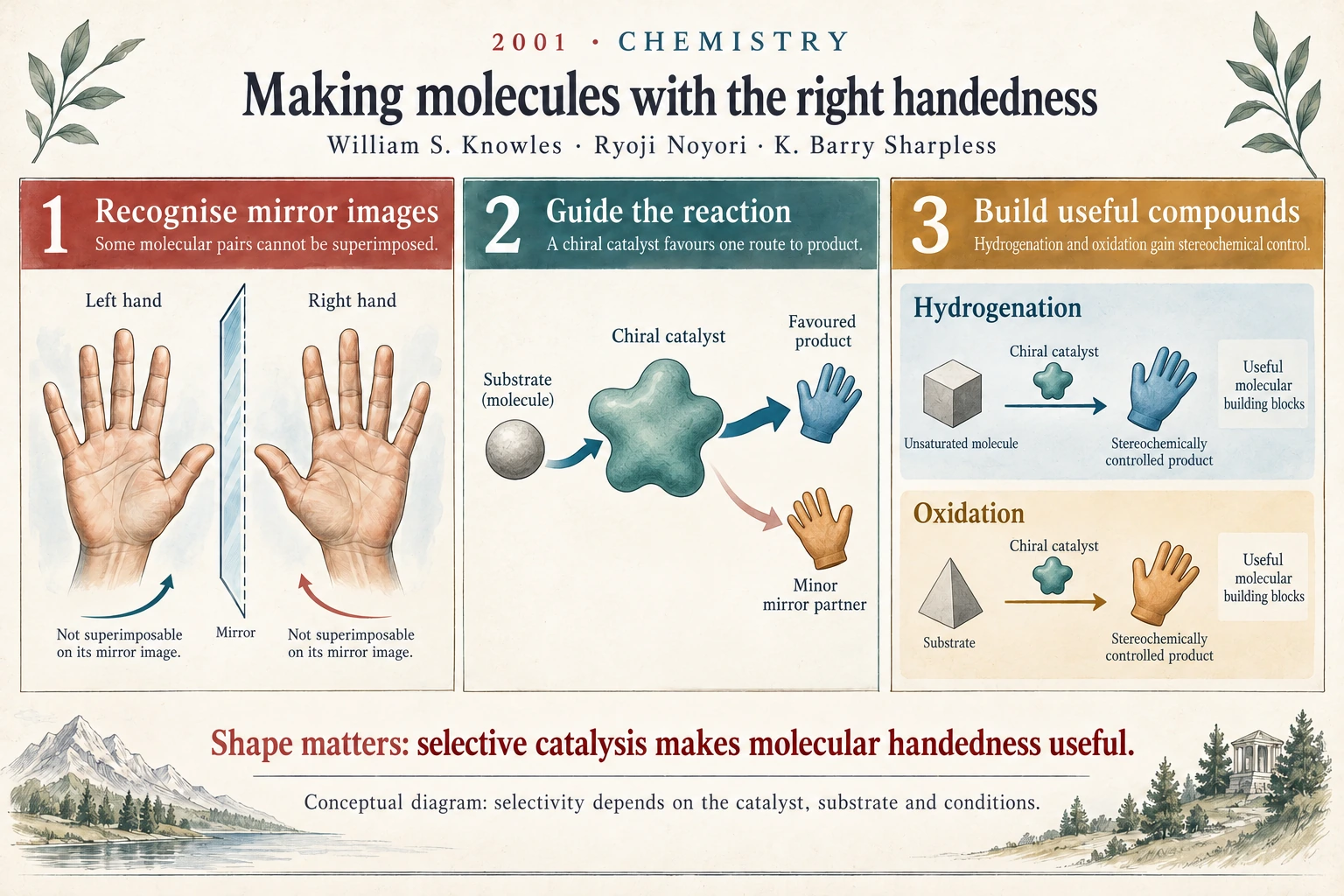
Some molecules come in two forms that are mirror images but cannot be superimposed, like left and right hands. These enantiomers can interact differently with other chiral molecules, including those in living systems. A synthesis that makes both forms equally may therefore be less useful than one that strongly favours the desired form.
Knowles and Noyori developed chirally catalysed hydrogenation, using catalysts that favour one product as hydrogen is added. Sharpless developed chirally catalysed oxidation, including highly useful asymmetric epoxidation. The three-dimensional environment of a chiral catalyst makes competing pathways differ, allowing a small amount of catalyst to guide the formation of many product molecules.
Why it matters
Asymmetric catalysis gave chemists more efficient routes to compounds with controlled stereochemistry. Knowles’s work enabled industrial production of L-DOPA, while the broader methods became valuable in pharmaceutical and fine-chemical synthesis. More selective reactions can reduce unwanted products and simplify purification, although each process still needs its own testing and optimisation.