c.curionodeThe Nobel Archive

1997 · Chemistry

Making ATP, then spending it

The prize joined ATP-synthase mechanics with the discovery of a pump that uses ATP to transport ions.

ATP synthasebinding-change mechanismsodium–potassium pumpenergy conversion
1997Chemistry

Visual guide

The prize, pictured

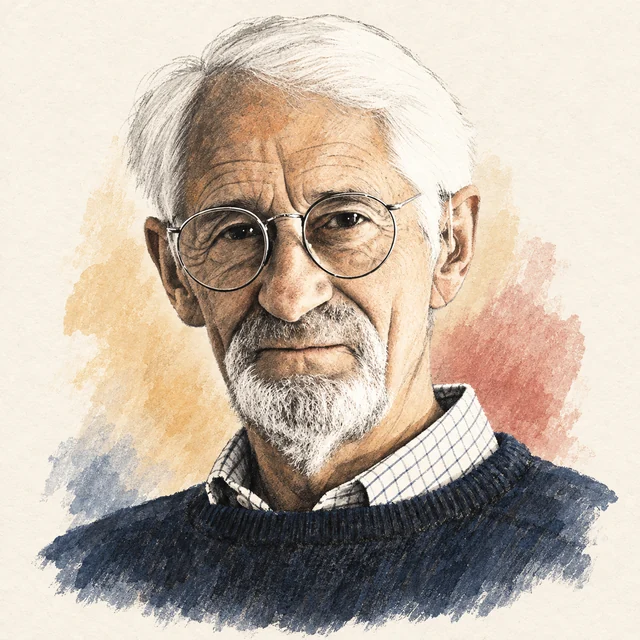
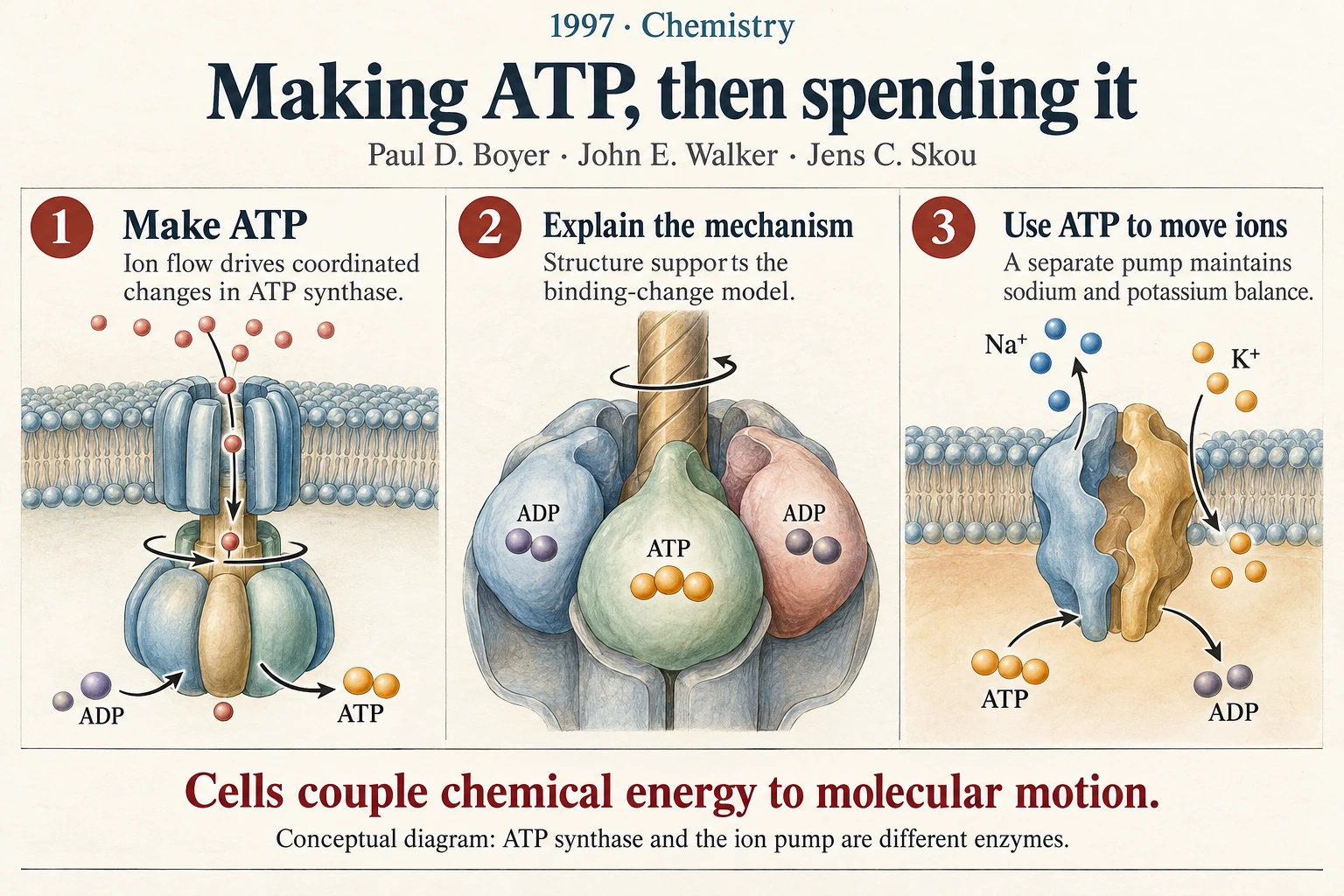
Infographic explaining Making ATP, then spending it
Original AI-generated infographic. A conceptual overview; the explanations and sources below provide context.
Read the poster text

Cells couple chemical energy to molecular motion.

  1. Make ATP

    Ion flow drives coordinated changes in ATP synthase.

  2. Explain the mechanism

    Structure supports the binding-change model.

  3. Use ATP to move ions

    A separate pump maintains sodium and potassium balance.

Conceptual diagram: ATP synthase and the ion pump are different enzymes.

01 · The discovery

The idea, in everyday language

Cells repeatedly form and consume ATP, a carrier of chemical energy. Boyer proposed that ATP synthase works through coordinated changes in its catalytic sites, coupled to rotation driven by an ion gradient. Walker and colleagues determined the structure of its catalytic portion in 1994, revealing the asymmetry and different site shapes that supported this mechanism. They shared half of the prize.

Skou received the other half for discovering sodium–potassium ATPase in 1957. This membrane enzyme uses ATP to support transport of sodium out of the cell and potassium into it, maintaining unequal ion concentrations. Both contributions concern energy conversion at membranes, but one explains ATP formation and the other a major way cells spend it.

Why it matters

The work connected biochemical reactions to molecular structure and directed membrane transport. It clarified central processes in respiration, cellular ion balance and electrical signalling. Walker’s structure and Boyer’s biochemical model were complementary; Skou’s discovery established a different class of membrane pump.
02 · The people

Who brought the idea to life?

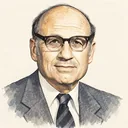
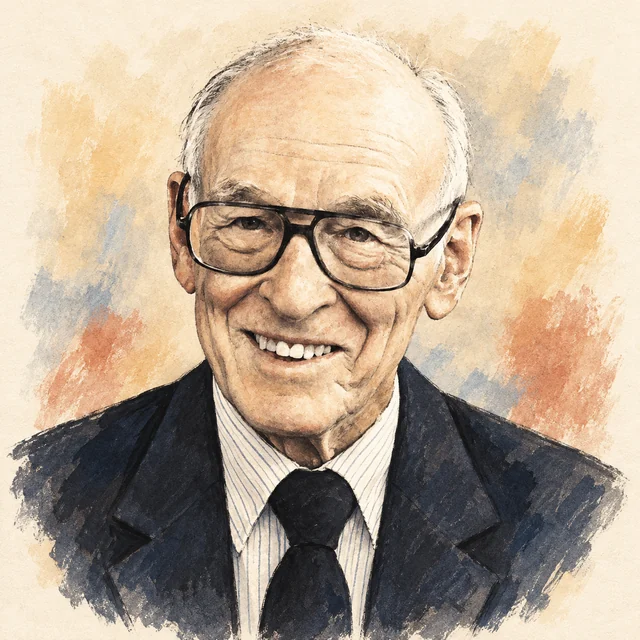
Illustrated portrait of Paul D. Boyer

Paul D. Boyer

Prize share · 1/4

Boyer proposed the binding-change mechanism of ATP synthase. Its catalytic sites cycle through states that bind substrates, form ATP and release it; rotation couples these changes to the flow of ions through the membrane-associated machinery. He shared half the prize with Walker, whose structural work supported this mechanism. Boyer’s own share was one quarter of the full prize.

Read the biography ↗
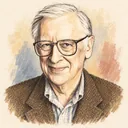
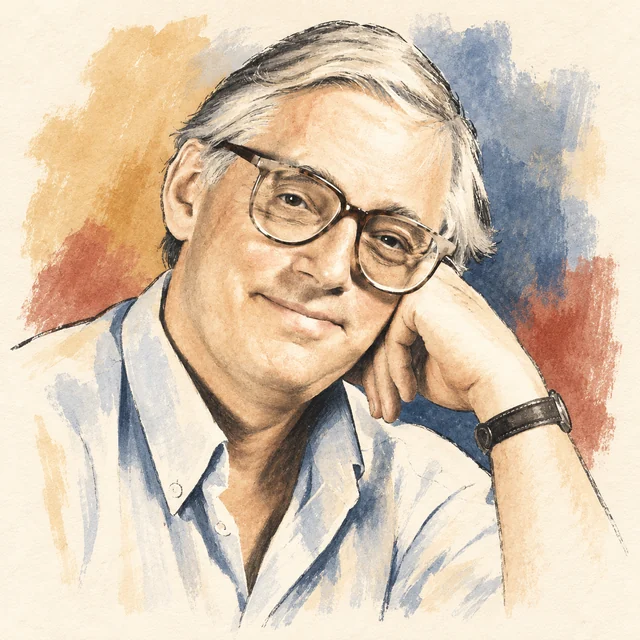
Illustrated portrait of John E. Walker

John E. Walker

Prize share · 1/4

Walker and collaborators determined amino-acid sequences and, in 1994, the three-dimensional structure of the catalytic F₁ portion of ATP synthase. The asymmetric central shaft and differently shaped catalytic sites supported Boyer’s binding-change mechanism. The structure was not the complete membrane complex, but it supplied crucial evidence for how rotation and shape changes are linked to ATP synthesis.

Read the biography ↗
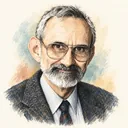
Illustrated portrait of Jens C. Skou

Jens C. Skou

Prize share · 1/2

In 1957 Skou described sodium–potassium ATPase, an enzyme associated with the pump that maintains different sodium and potassium concentrations inside and outside cells. It uses ATP rather than making it. This ion balance supports functions such as electrical signalling and control of cell volume. Skou received half the prize for discovering an ion-transporting enzyme, a distinct contribution from Boyer and Walker’s ATP-synthase work.

Read the biography ↗

03 · Years in the making

The path here

  1. 1957

    Skou described sodium–potassium ATPase.

  2. 1974

    Boyer presented the ATP-synthase mechanism described in the Nobel account.

  3. 1994

    Walker and collaborators determined the catalytic F₁ structure.

  4. 1997

    The prize linked ATP synthesis and ATP-driven ion transport.

04 · Read further

From the original sources

Original explanations by Curionode, based on the official records below. Biographical details and affiliations refer to the award year.

  1. Official announcement nobelprize.org

More in Chemistry

Browse this subject ↗