A life in context
The person behind the prize
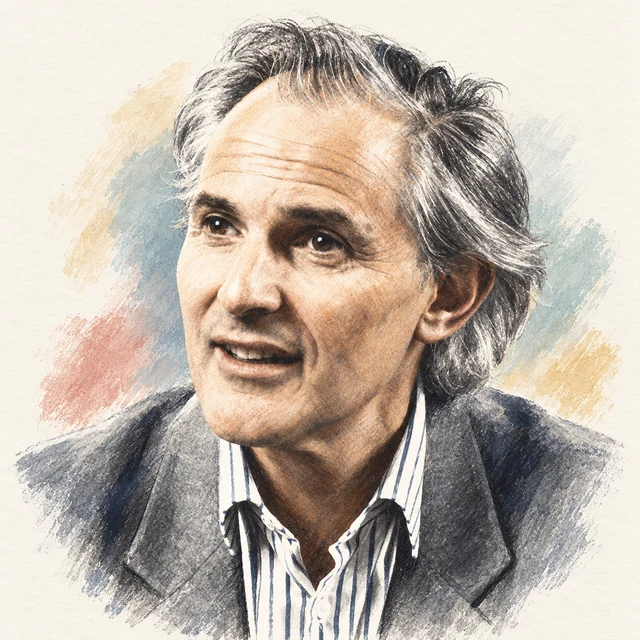
Kroto was born in England to parents who had left Berlin and grew up in Bolton. He combined interests in chemistry and visual design, studying at Sheffield before building a research career in molecular spectroscopy. At Sussex he investigated carbon-rich environments in space. A question about how long carbon chains could form in stellar atmospheres led him to the Rice cluster experiments that unexpectedly produced fullerenes.
The contribution
Kroto brought the astrophysical motivation and carbon-chain expertise to the 1985 collaboration with Curl and Smalley. When stable C60 clusters appeared, the researchers proposed a highly symmetric closed carbon cage. The discovery changed their original question: carbon could assemble into molecular shells as well as chains. Bulk production by other researchers in 1990 later allowed the proposed cage structure to be confirmed.
The idea in plain language
Carbon can form radically different structures, including diamond and graphite. In 1985, a Rice collaboration brought Kroto’s interest in carbon chains in stellar environments together with Curl’s spectroscopy and Smalley’s cluster-beam apparatus. Laser pulses vaporised graphite; the carbon cooled and assembled into clusters that could be analysed by mass spectrometry.
Read the full award story ↗