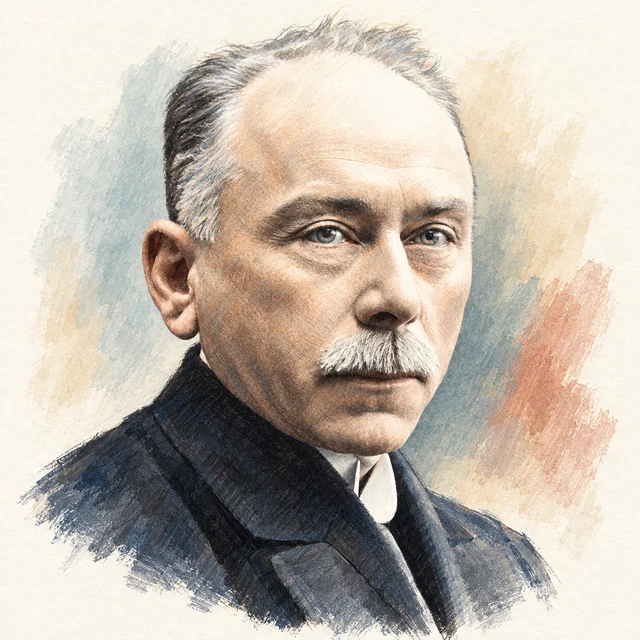
A life in context
The person behind the prize
Bordet was born in Soignies, Belgium, and qualified in medicine at the University of Brussels in 1892. From 1894 to 1901 he worked at the Pasteur Institute in Paris, studying the activity of blood serum against microorganisms. An important question was why serum from an immunised animal could act against particular bacteria and what other factors were needed. His investigations distinguished a specific antibody component from another serum component, now called complement, that was also present without the same prior immunisation. Their cooperation helped explain bacterial destruction in the reactions he studied. He returned to Belgium to direct the Pasteur Institute in Brussels and became professor of bacteriology at Brussels University in 1907, his official Nobel affiliation. Work with Octave Gengou developed the study of complement fixation; the two also cultivated the bacterium associated with whooping cough in 1906. These were related parts of a wider research career, not a claim that Gengou shared this Nobel award. The 1919 Medicine Prize was reserved and announced for Bordet on 28 October 1920. He was lecturing in the United States and did not attend the December presentation. He later continued his research and teaching in Brussels and died there in 1961. His award concerns discoveries about immunity, not a complete account of every immune response or a medical test readers can perform themselves.
The contribution
Bordet received the full Medicine Prize for discoveries relating to immunity. By distinguishing specific antibodies from complement and studying their interaction, he helped explain how blood serum can act against bacteria and other cells.
The idea in plain language
Serum can act against microorganisms, but that activity is not one indivisible property. Bordet’s investigations, including work on cholera, distinguished a factor made specific by immunisation from another component already present in serum without the same immunisation. In today’s language, antibodies provide specific recognition while complement contributes other parts of the reaction.
Read the full award story ↗

