01 · The discovery
The idea, in everyday language
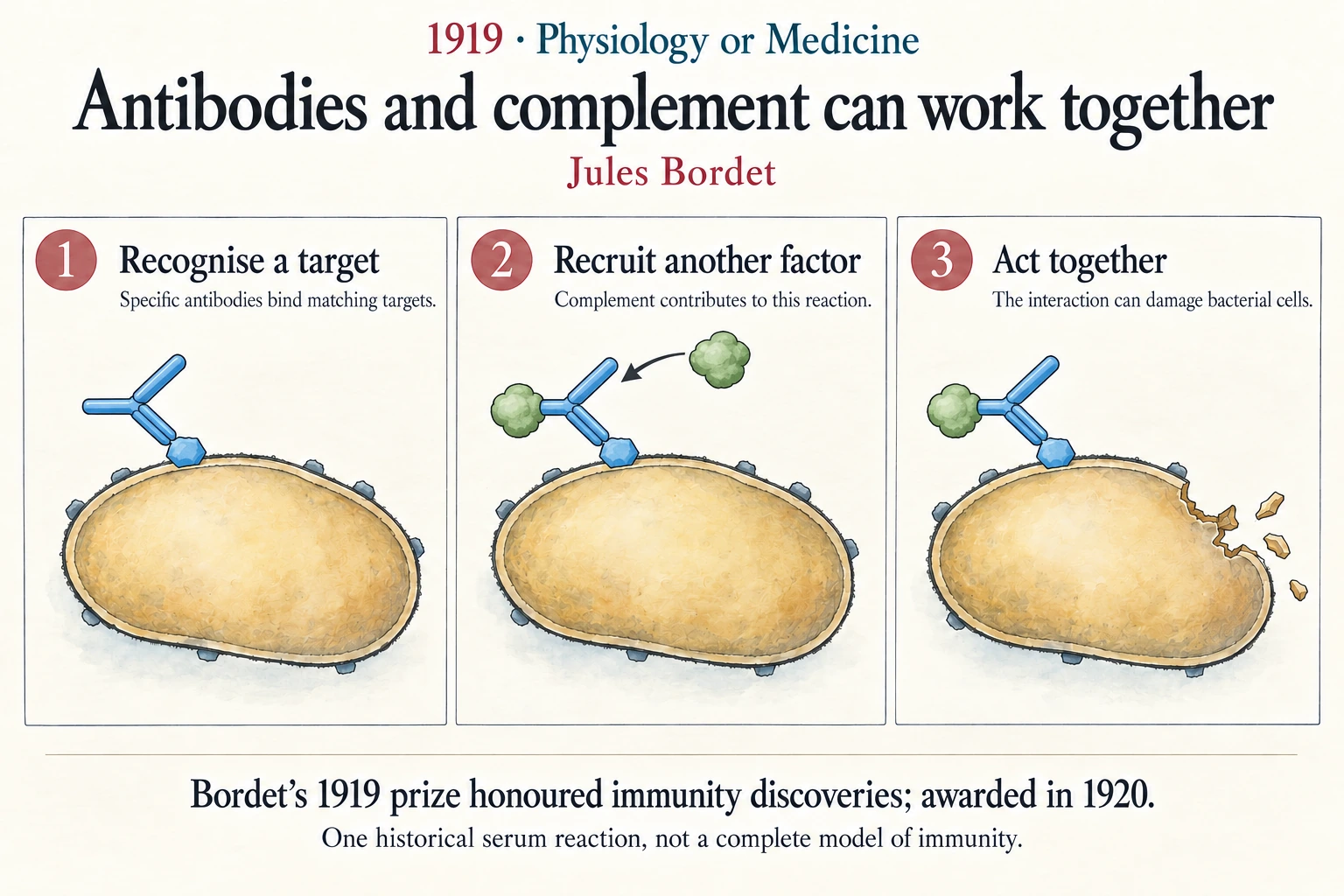
Serum can act against microorganisms, but that activity is not one indivisible property. Bordet’s investigations, including work on cholera, distinguished a factor made specific by immunisation from another component already present in serum without the same immunisation. In today’s language, antibodies provide specific recognition while complement contributes other parts of the reaction.
By separating the contributions experimentally and studying their interaction, he helped explain bacteriolysis and related reactions against cells. With Octave Gengou he developed work on complement fixation, connecting basic observations with ways of detecting immune reactions. The 1919 Medicine Prize was reserved, announced for Bordet on 28 October 1920 and presented on 10 December 1920. He was then lecturing in the United States; the Belgian minister accepted on his behalf.
Why it matters
The distinction made immunity more open to analysis: recognition and the ensuing reaction could be studied as cooperating components. Complement fixation also became important in the history of laboratory investigation. The achievement helped establish a molecular account of serum activity while leaving many mechanisms and immune responses to later research.