01 · The discovery
The idea, in everyday language
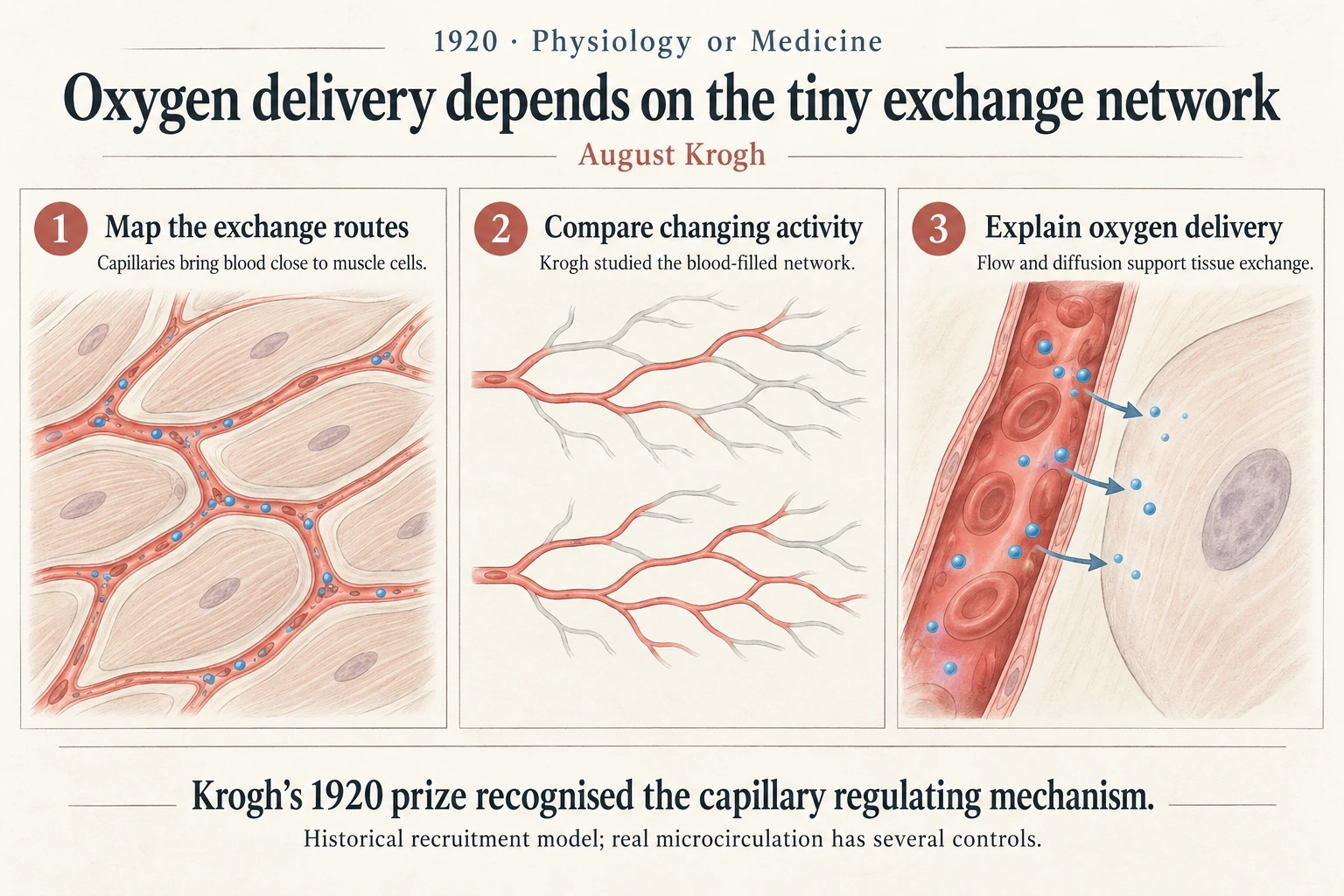
Working muscle needs more oxygen. Blood must carry it close enough to the cells for exchange across the walls of tiny vessels, the capillaries. A greater overall blood flow is part of the response, but the arrangement and effective use of the exchange network also matter.
Krogh measured diffusion, used calculations to relate the capillary network to surrounding tissue, and observed changes in blood-filled vessels under the microscope. He interpreted his results through recruitment: previously unperfused routes becoming available as activity increased. This historical model connected changing tissue demand with the effective surface for exchange. It was the capillary work, rather than the earlier demonstration of lung diffusion alone, that the 1920 prize singled out.
Why it matters
Krogh made tissue oxygen supply a quantitative problem linking blood flow, diffusion and the microvascular network. His instruments, experiments and model helped establish a research programme that could investigate how local exchange meets changing demands.