A life in context
The person behind the prize
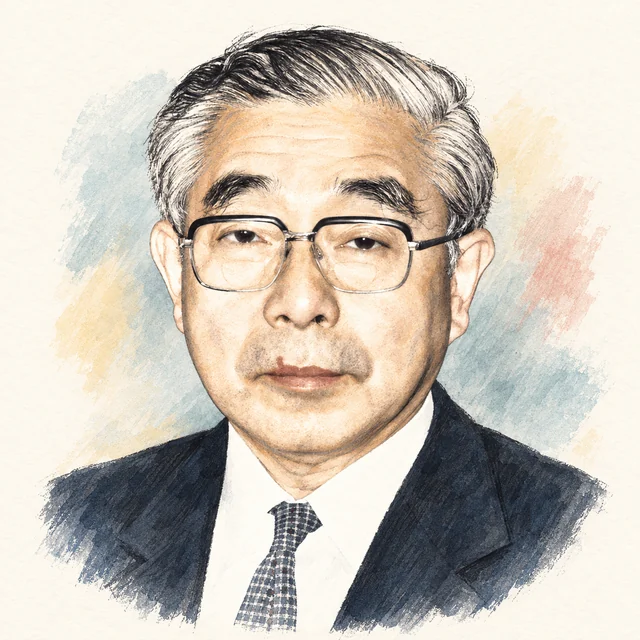
Fukui did not initially regard chemistry as his favourite school subject. Advice from Gen-itsu Kita led him to industrial chemistry at Kyoto Imperial University, where he graduated in 1941. He worked on synthetic fuels and continued experimental chemistry while building a theoretical research group. He became professor in 1951. In 1952 he connected chemical reactivity in aromatic compounds with the distribution of frontier electrons. His group developed this into an approach based on interactions between occupied and unoccupied molecular orbitals, drawing also on Robert Mulliken’s work. Later studies traced reaction paths and molecular geometry. Fukui’s presidency of Kyoto Institute of Technology began in 1982, after the Nobel award at Kyoto University.
The contribution
Fukui showed why frontier orbitals can be especially useful for understanding how reactants interact. Their energies, spatial shapes and wave-function phases help explain reactivity. He received one half of the Chemistry Prize, independently of Hoffmann’s complementary orbital-symmetry work; the methods guide reasoning rather than guarantee every reaction outcome.
The idea in plain language
Knowing which atoms are present does not by itself explain why a reaction follows one path rather than another. Electrons occupy molecular orbitals: quantum states with energies and spatial wave-function patterns. Fukui focused attention on frontier orbitals, especially the highest occupied and lowest unoccupied states. Their energies and patterns help describe how electrons can be redistributed when reactants approach.
Read the full award story ↗