A life in context
The person behind the prize
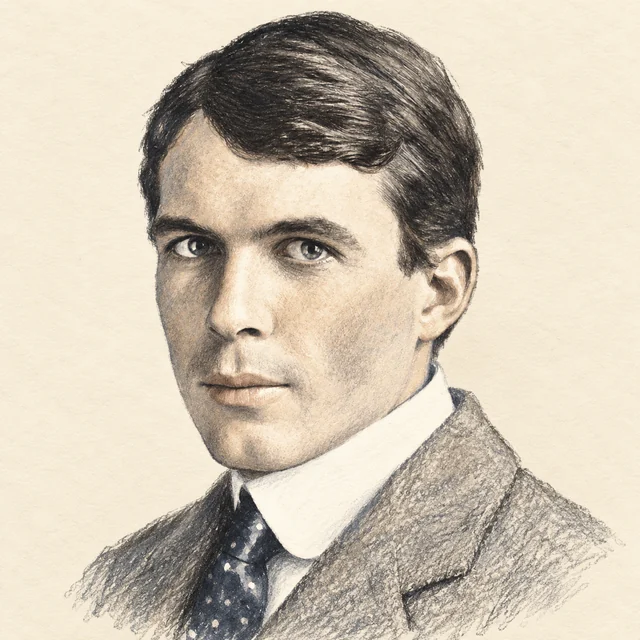
William Lawrence Bragg was born in Adelaide and studied mathematics at its university before moving to Britain with his family in 1909. At Trinity College, Cambridge, he turned towards physics. In 1912 he investigated the diffraction patterns discovered by Max von Laue and colleagues. He interpreted the regular arrangement of atoms through families of crystal planes and related the directions of strong diffraction to X-ray wavelength and plane spacing. The International Union of Crystallography dates the presentation of this approach to November 1912 and publication to 1913. Working with his father, he used X-ray evidence to investigate crystal structures. Their complementary theory and measurements earned equal shares of the 1915 Physics Prize, when Lawrence was 25. He had become a fellow and lecturer at Trinity in 1914 and served in wartime sound ranging from 1915 to 1919. The Nobel facts page associates him with Manchester at the award, but the dated Nobel biography places his Manchester professorship in 1919; this guide uses the earlier Trinity and wartime context for 1915. Trinity’s short biography republishes the Nobel Lectures account, rather than providing independent confirmation. Later he directed the National Physical Laboratory, worked at Cambridge and the Royal Institution, and helped sustain the development of structural research, including protein crystallography. He was knighted in 1941 and died in 1971.
The contribution
William Lawrence Bragg received half the Physics Prize for the geometrical interpretation and structural use of X-ray diffraction. His reflection condition connected wavelength, crystal-plane spacing and angle, complementing his father’s instruments and measurements.
The idea in plain language
A crystal scatters X-rays from a repeating arrangement of atoms. Contributions from different parts can reinforce or cancel. Lawrence Bragg described the strong directions using families of parallel crystal planes: 2d sin θ = nλ. Here d is the spacing between planes, λ the wavelength, n an integer and θ the angle measured from the planes, not from their normal. This geometrical reflection picture expresses an interference condition; the planes are not ordinary tiny mirrors.
Read the full award story ↗