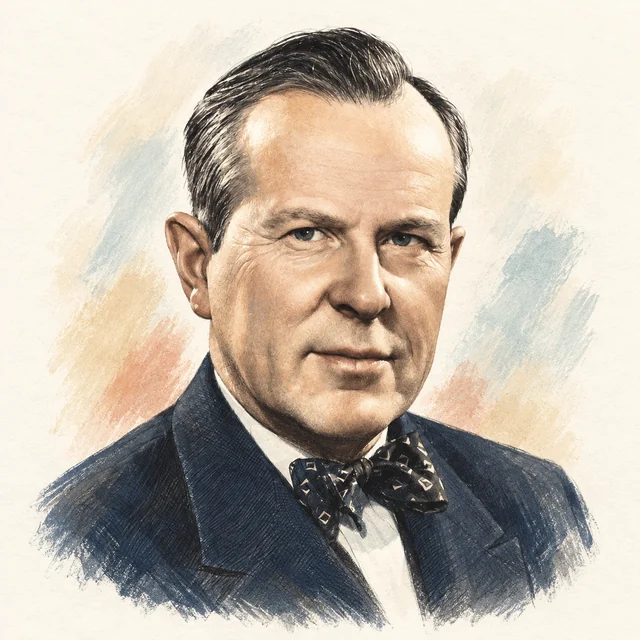
A life in context
The person behind the prize
Pearson’s Toronto education, interrupted by wartime service, led to graduation in 1919 and later study at Oxford. He taught history in Toronto from 1924 and entered Canada’s diplomatic service in 1928. London work from 1935 and wartime service in Washington preceded his appointment as undersecretary for external affairs in 1946. He served as Secretary of State for External Affairs from 1948 until June 1957 and as president of the UN General Assembly’s seventh session in 1952–1953. During the 1956 Suez crisis, he helped develop the proposal for a United Nations Emergency Force to support a ceasefire and withdrawal. This depended on international negotiation and shared work, including that of Dag Hammarskjöld and Ralph Bunche. He received the full 1957 prize after leaving his ministerial office. UNEF was the first armed UN peacekeeping force, following earlier unarmed observer missions. His later Canadian premiership from 1963 to 1968 belongs to subsequent history.
The contribution
Pearson helped develop multilateral arrangements for the Suez ceasefire, especially the proposal for a United Nations Emergency Force. He received the full Peace Prize.
The idea in plain language
The 1956 Suez crisis involved military intervention by Israel, Britain and France in Egypt and posed a wider threat to international relations. A ceasefire needed more than a declaration: negotiation had to create practical arrangements supporting withdrawal and reducing the danger of renewed fighting.
Read the full award story ↗

