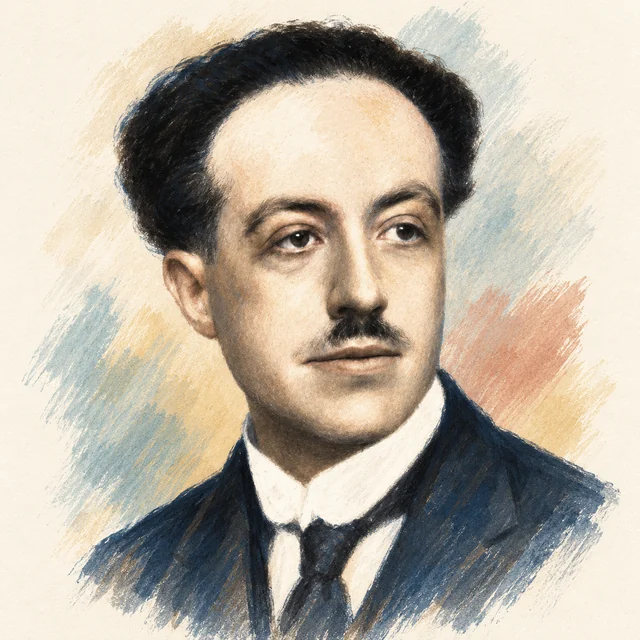
A life in context
The person behind the prize
De Broglie first studied history, gaining a degree in 1910, before turning to science and completing another degree in 1913. Military service during the First World War placed him in wireless communications at the Eiffel Tower. After the war he pursued theoretical physics, influenced in part by the experimental work of his elder brother Maurice. His 1924 doctoral thesis at the University of Paris proposed that matter, including electrons, has a wave character. This extended the emerging connection between waves and particles beyond light. Electron diffraction experiments by Clinton Davisson and Lester Germer in 1927 provided important independent confirmation. De Broglie taught at the Sorbonne and the Institut Henri Poincaré; his university chair from 1932 belonged to a later stage of his career. The full 1929 Physics Prize recognized the wave nature of electrons. He continued to explore wave mechanics and its interpretation, including later work on causal accounts of quantum phenomena. Those interpretations should not be confused with the experimentally established diffraction effect. He died in 1987.
The contribution
De Broglie received the full Physics Prize for discovering the wave nature of electrons. His theoretical proposal connected matter with wave behaviour, later tested through electron diffraction.
The idea in plain language
Light had already challenged the division between waves and particles. De Broglie asked whether the connection could extend to matter. His 1924 doctoral work associated wave behaviour with electrons and helped open the way to wave mechanics.
Read the full award story ↗

