c.curionodeThe Nobel Archive

1929 · Physics

When matter shows a wave nature

De Broglie proposed that electrons have wave properties. Later diffraction experiments showed patterns that a simple picture of independent classical particles could not explain.

Matter wavesElectron diffractionQuantum mechanicsWave–particle behaviour
1929Physics

Visual guide

The prize, pictured

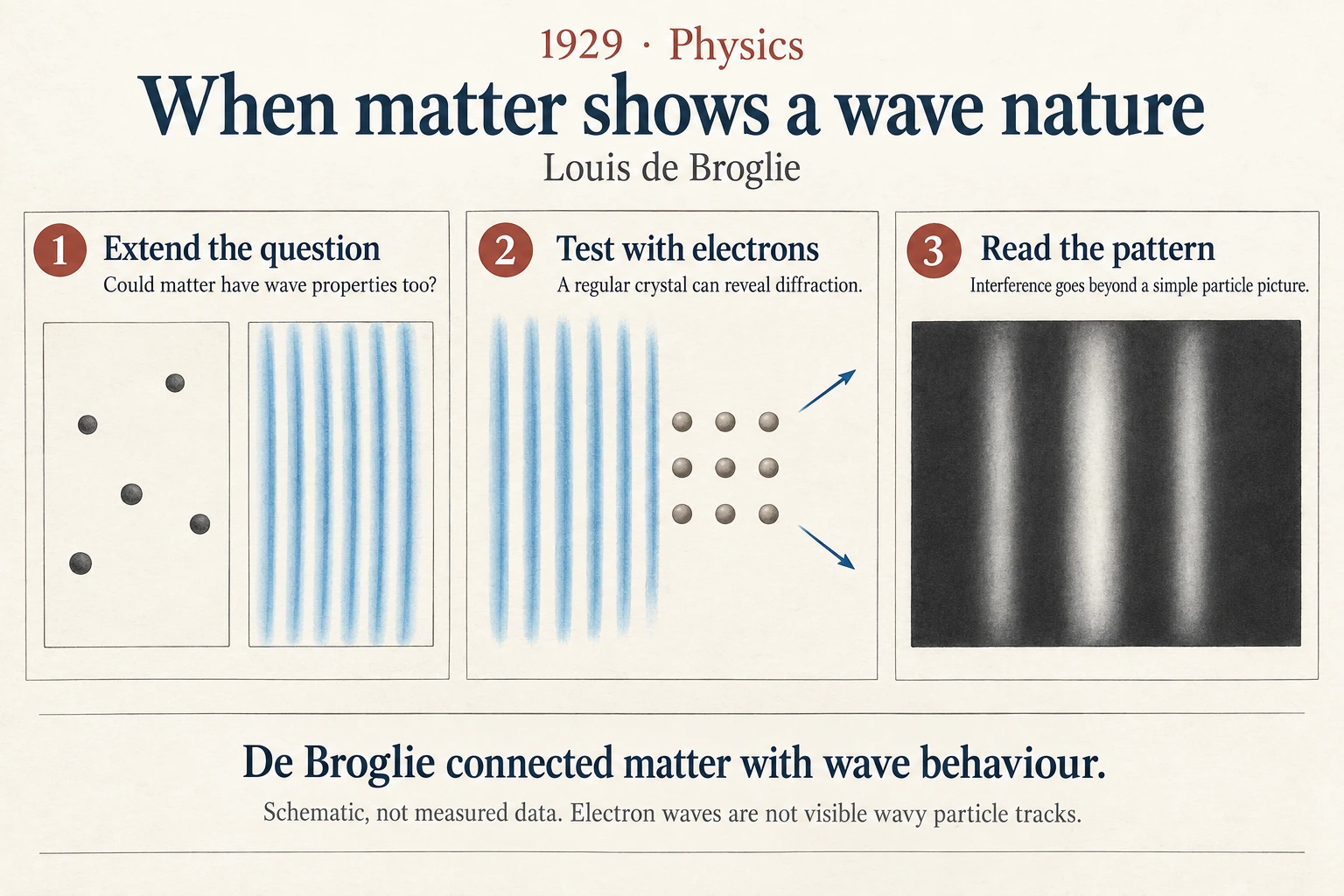
Infographic explaining When matter shows a wave nature
Original AI-generated infographic. A conceptual overview; the explanations and sources below provide context.
Read the poster text

De Broglie connected matter with wave behaviour.

  1. Extend the question

    Could matter have wave properties too?

  2. Test with electrons

    A regular crystal can reveal diffraction.

  3. Read the pattern

    Interference goes beyond a simple particle picture.

Schematic, not measured data. Electron waves are not visible wavy particle tracks.

01 · The discovery

The idea, in everyday language

Light had already challenged the division between waves and particles. De Broglie asked whether the connection could extend to matter. His 1924 doctoral work associated wave behaviour with electrons and helped open the way to wave mechanics.

A regular crystal can reveal this behaviour through diffraction: different scattered contributions combine in a pattern of reinforced and reduced intensity. Electron experiments by Davisson and Germer in 1927 provided important evidence. The result concerned the behaviour of matter, rather than a new kind of ordinary light scattered from it.

Why it matters

Matter waves became a foundation of quantum mechanics and of methods that use electron diffraction to investigate structure. The 1929 prize recognized de Broglie’s theoretical discovery; the experimental tests and later instruments also depended on the work of other researchers.
02 · The people

Who brought the idea to life?

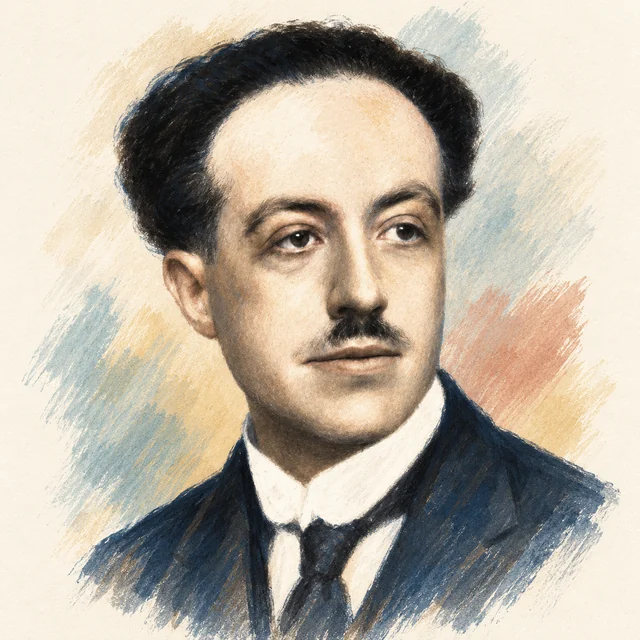
Illustrated portrait of Louis de Broglie

Louis de Broglie

Prize share · 1

De Broglie received the full Physics Prize for discovering the wave nature of electrons. His theoretical proposal connected matter with wave behaviour, later tested through electron diffraction.

Read the biography ↗

03 · Years in the making

The path here

  1. 1924

    De Broglie presents his doctoral thesis on quantum theory in Paris.

  2. 1927

    Davisson and Germer observe electron diffraction by a crystal.

  3. 1929

    De Broglie receives the full Physics Prize for the wave nature of electrons.

04 · Read further

From the original sources

Original explanations by Curionode, based on the official records below. Biographical details and affiliations refer to the award year.

  1. Official award summary nobelprize.org
  2. Award ceremony speech nobelprize.org