A life in context
The person behind the prize
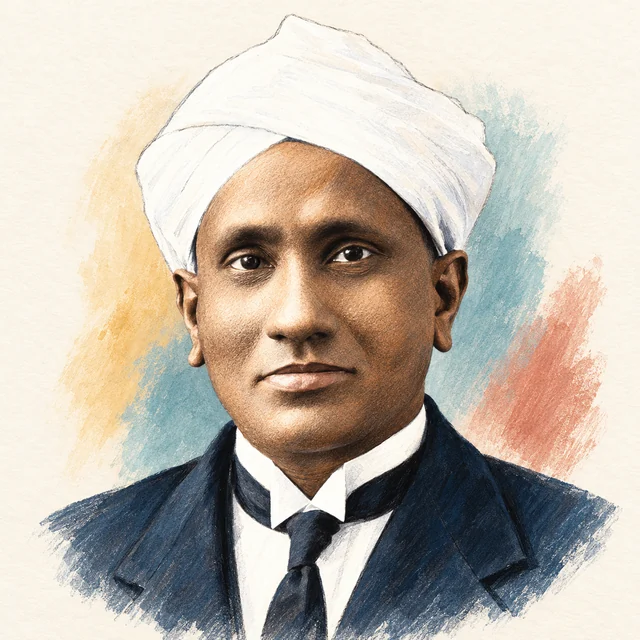
Raman studied at Presidency College in Madras, earning his bachelor’s degree in 1904 and master’s degree in 1907. He joined the Indian Finance Department while continuing experiments at the Indian Association for the Cultivation of Science in Calcutta. In 1917 he became the university’s Palit Professor of Physics. His early work covered acoustics, musical instruments and optics. A sustained investigation of scattered light led to the effect identified in 1928; the original Nature announcement was co-authored with K. S. Krishnan. A small part of the scattered light had frequencies different from the incident light, revealing an exchange of energy with matter. Raman was knighted in 1929 and received the full 1930 Physics Prize. His award affiliation was Calcutta University. His later career in Bangalore included the Indian Institute of Science from 1933 and the Raman Research Institute from 1948. Those later institutions should not replace his award-year context.
The contribution
Raman received the full Physics Prize for research on light scattering and discovery of the effect bearing his name. The changed frequencies in a small fraction of scattered light opened a way to study molecular energy changes and structure.
The idea in plain language
Ordinary elastic scattering changes light’s direction without changing its frequency. Raman’s experiments revealed something additional: weak lines at frequencies different from the incoming light. Filtered light from a mercury lamp made the comparison clearer. The original 1928 announcement in Nature was co-authored by Raman and K. S. Krishnan. The Nobel Prize was awarded to Raman alone.
Read the full award story ↗

