01 · The discovery
The idea, in everyday language
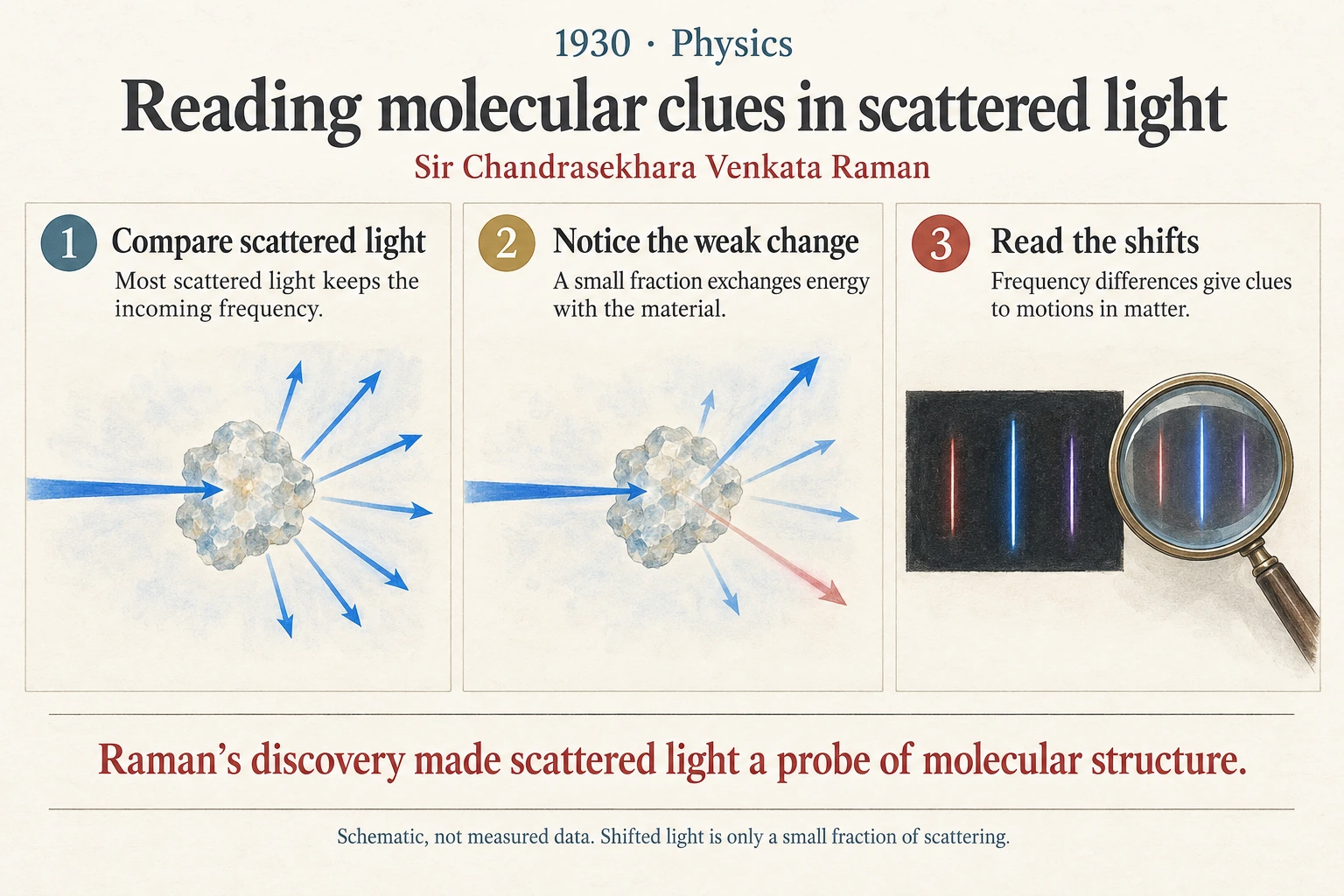
Ordinary elastic scattering changes light’s direction without changing its frequency. Raman’s experiments revealed something additional: weak lines at frequencies different from the incoming light. Filtered light from a mercury lamp made the comparison clearer. The original 1928 announcement in Nature was co-authored by Raman and K. S. Krishnan. The Nobel Prize was awarded to Raman alone.
In the shifted scattering, light exchanges energy with the material. The frequency difference can reveal changes in molecular vibration or rotation and other excitations in matter. Light may lose or gain energy in that exchange, so shifted lines can occur on either side of the incident frequency. Studying these offsets turned a subtle optical effect into a way to investigate molecular motions and chemical structure.
Why it matters
Raman spectroscopy became an important way to investigate materials and molecular structure. The 1928 experiments used the light sources and optical instruments of their time. Lasers and many modern instruments arrived later; they were not part of the original discovery.