A life in context
The person behind the prize
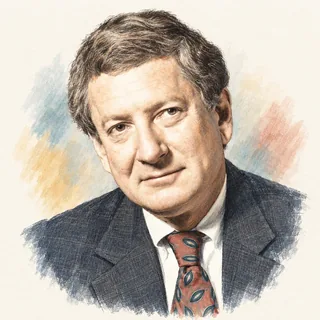
Rodbell grew up in Baltimore with interests in languages and chemistry. After wartime naval service, study at Johns Hopkins and the University of Washington drew him into biochemistry and membrane research. His investigations at the National Institutes of Health asked how a hormone’s message reaches a cell’s internal machinery. At the award he was associated with the National Institute of Environmental Health Sciences in North Carolina.
The contribution
Rodbell distinguished three functions in hormone signalling: a receptor that recognises the signal, a transducer that relays it, and an amplifier that generates an intracellular response. Around 1970 he showed the importance of GTP in the transducer step. This framework suggested a separate coupling component rather than a receptor acting directly on every target. Gilman later identified the relevant G-protein biochemically; they shared the prize equally.
The idea in plain language
A hormone may bind to a receptor on the outside of a cell, but how does that event influence processes inside? Rodbell distinguished recognition, transduction and amplification as separate functions, and demonstrated a role for GTP in the coupling step. This suggested that a receptor needed a molecular relay rather than simply acting directly on the response machinery.
Read the full award story ↗