A life in context
The person behind the prize
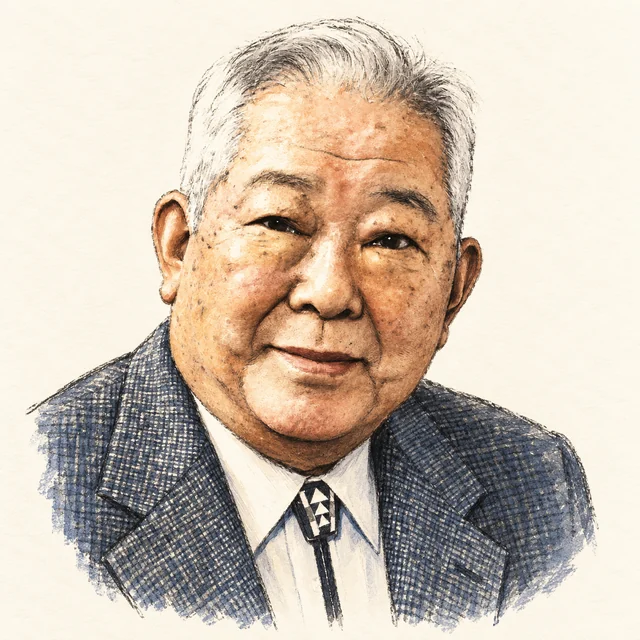
Koshiba studied physics in Japan and earned his doctorate at the University of Rochester in 1955. His career at the University of Tokyo connected elementary-particle experiments with questions about the cosmos. The Kamiokande detector, built deep underground in Japan, used a large water tank surrounded by sensitive light sensors. Its observations showed how a particle detector could also become an astronomical observatory.
The contribution
Koshiba and his collaborators detected faint light from charged particles produced in neutrino interactions. Unlike a radiochemical count, these events carried timing and directional information. Kamiokande observed solar neutrinos and, in 1987, a burst associated with supernova SN 1987A. The burst provided direct evidence of neutrinos from a stellar collapse far beyond our Solar System. It was observed by other detectors as well.
The idea in plain language
Visible light tells only part of the story of the sky. Neutrinos interact so weakly with matter that they can escape from places, such as the Sun’s interior, that light does not reveal directly. That same property makes them difficult to catch. Davis used a chemical transformation in a huge underground tank to count solar neutrinos. Koshiba used a water detector whose light sensors could register the timing and direction of individual interactions.
Read the full award story ↗