A life in context
The person behind the prize
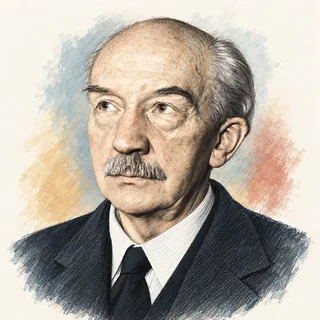
Born studied mathematics, physics and astronomy at several European universities before completing doctoral work at Göttingen on elastic stability. The work won a university prize in 1906. He developed research on relativity and crystal lattices, became professor in Frankfurt in 1919 and moved to Göttingen in 1921. With Heisenberg and Jordan, he helped give matrix mechanics its mathematical form in 1925–1926. His statistical interpretation in 1926 connected the wavefunction with probabilities of measurement outcomes. Nazi persecution forced him to leave Germany in 1933 because of his Jewish ancestry. After Cambridge and a period in Bangalore, he became Tait Professor at Edinburgh in 1936, retiring in 1953. Edinburgh was the affiliation listed for his half of the 1954 prize. Bothe’s coincidence measurements were a separate contribution recognised in the other half. Born’s later participation in the 1957 Göttingen declaration against nuclear weapons belongs to subsequent history.
The contribution
Born developed quantum mechanics and its statistical interpretation, connecting the wavefunction with probabilities of measurement outcomes. He received one half of the Physics Prize.
The idea in plain language
What does a quantum wavefunction predict about an experiment? In 1926 Born connected it with probabilities of measurement outcomes. Alongside his work with Heisenberg and Jordan on matrix mechanics, this helped turn quantum theory into a framework relating mathematical descriptions to observable results. A probability distribution specifies possible outcomes and their weights, rather than a guaranteed result for each trial.
Read the full award story ↗