A life in context
The person behind the prize
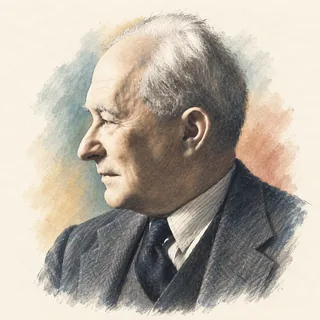
Bothe studied at Berlin under Max Planck and obtained his doctorate just before the First World War. Work at the Physikalisch-Technische Reichsanstalt began in 1913 and continued after wartime captivity. In the 1920s he collaborated with H. Geiger on coincidence measurements, relating signals registered close together in time. Experiments addressed whether energy and momentum were conserved in individual scattering events. In 1929 work with W. Kolhörster used coincidence methods to investigate penetrating cosmic radiation. Bothe became professor at Giessen in 1930 and at Heidelberg in 1932; in 1934 he directed the physics institute of the Kaiser Wilhelm Institute for Medical Research, later part of the Max Planck organisation. His wider research included nuclear reactions and instrumentation. Radiation reported with H. Becker in 1930 preceded Chadwick’s identification of the neutron in 1932. Bothe received half of the 1954 prize for the coincidence method and discoveries using it; Born received the other half for different theoretical work.
The contribution
Bothe developed and applied coincidence measurements to investigate individual interactions and cosmic radiation. He received one half of the Physics Prize.
The idea in plain language
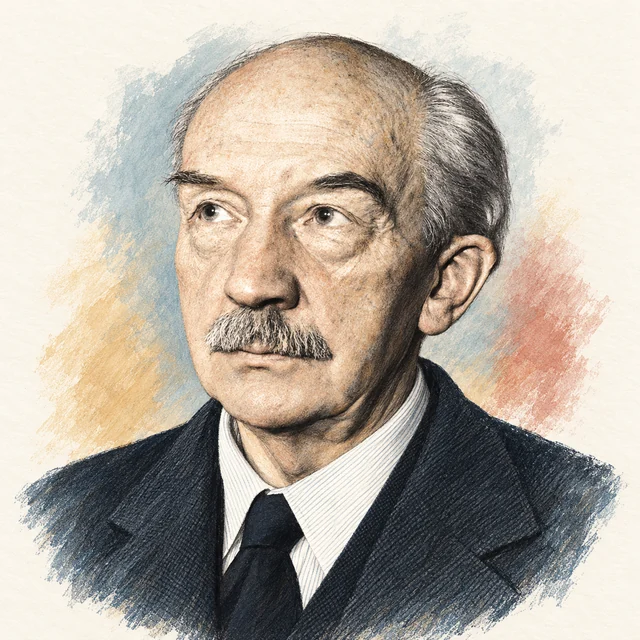
What does a quantum wavefunction predict about an experiment? In 1926 Born connected it with probabilities of measurement outcomes. Alongside his work with Heisenberg and Jordan on matrix mechanics, this helped turn quantum theory into a framework relating mathematical descriptions to observable results. A probability distribution specifies possible outcomes and their weights, rather than a guaranteed result for each trial.
Read the full award story ↗