01 · The discovery
The idea, in everyday language
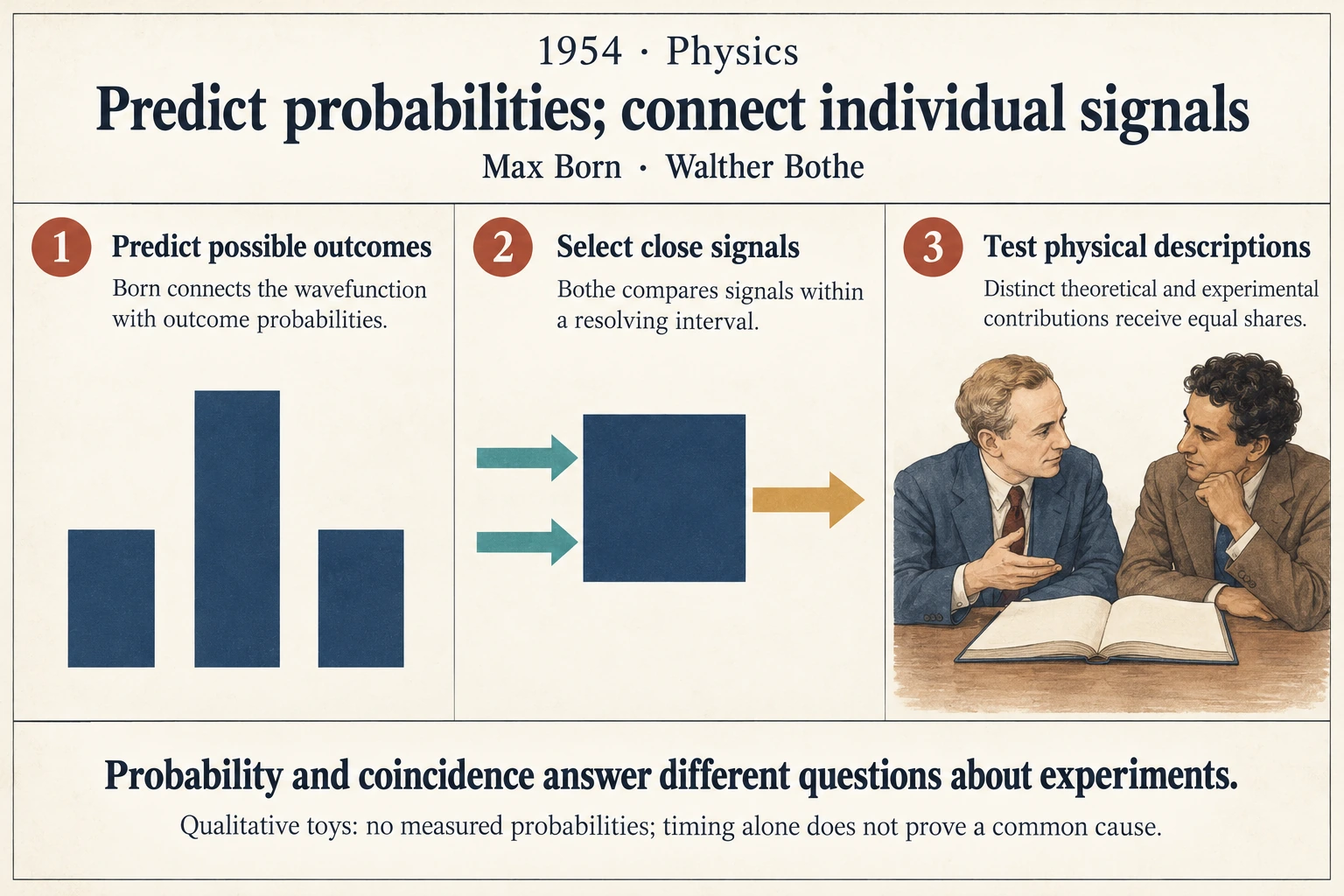
What does a quantum wavefunction predict about an experiment? In 1926 Born connected it with probabilities of measurement outcomes. Alongside his work with Heisenberg and Jordan on matrix mechanics, this helped turn quantum theory into a framework relating mathematical descriptions to observable results. A probability distribution specifies possible outcomes and their weights, rather than a guaranteed result for each trial.
Bothe addressed a different problem: how to determine which detector signals belong together. With Hans Geiger in 1924–1925, he investigated the relationship between scattered light and recoil electrons. Coincidence measurements compared signals close together in time, with attention to instrumental resolution and accidental coincidences. They supported conservation in individual interactions, against a proposal that energy conservation applied only statistically. Work with W. Kolhörster in 1929 extended the method to cosmic radiation. Born and Bothe each received half of the 1954 prize for distinct contributions.
Why it matters
Born’s interpretation became central to connecting quantum theory with measurement. Bothe’s method helped investigate scattering, cosmic radiation and nuclear reactions. Their contributions concern both predictions and the experimental evidence used to assess physical descriptions; they were not one joint experiment.