A life in context
The person behind the prize
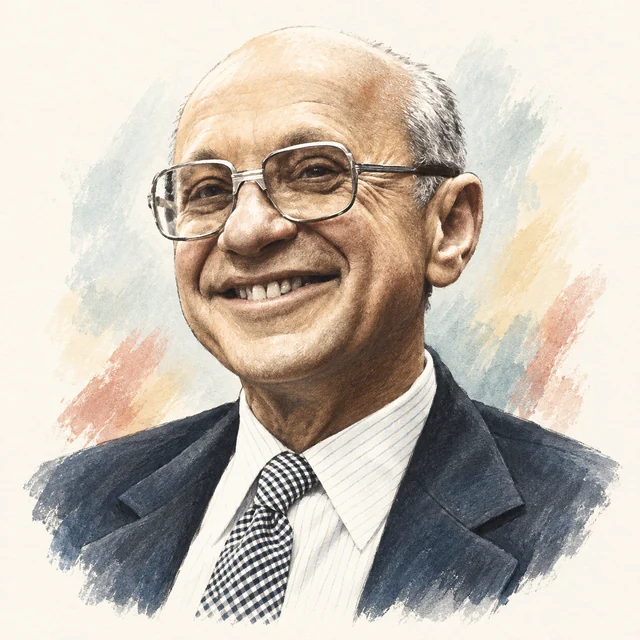
Friedman grew up in Rahway, New Jersey, and studied mathematics and economics at Rutgers. Graduate work at Chicago and Columbia exposed him to different theoretical and empirical traditions. Consumer-budget research and work with Simon Kuznets developed distinctions between permanent and transitory income. Conversations with Rose Friedman, Dorothy Brady and Margaret Reid helped shape his consumption theory. He joined Chicago’s faculty in 1946, combining teaching with research at the National Bureau of Economic Research. With Anna Schwartz he investigated monetary history, while a workshop connected theory and evidence across a wider group. His policy arguments stressed uncertainty, expectations and the difficulty of stabilising an economy. Public advocacy extended beyond the recognised research; the 1976 memorial prize did not endorse every political position he expressed.
The contribution
Friedman received the full Economic Sciences memorial prize for consumption analysis, monetary history and theory, and demonstrating the complexity of stabilisation policy. His work offered influential hypotheses and evidence, not guaranteed rules for every economy or household.
The idea in plain language
The permanent-income hypothesis distinguishes a household’s longer-term expected resources from temporary fluctuations in receipts. A one-off increase need not produce the same spending response as a sustained change. This helped explain why consumption can behave differently from current income. The hypothesis is an analytical model, not a statement that every household can borrow freely or save a temporary windfall: uncertainty, credit limits and circumstances matter.
Read the full award story ↗