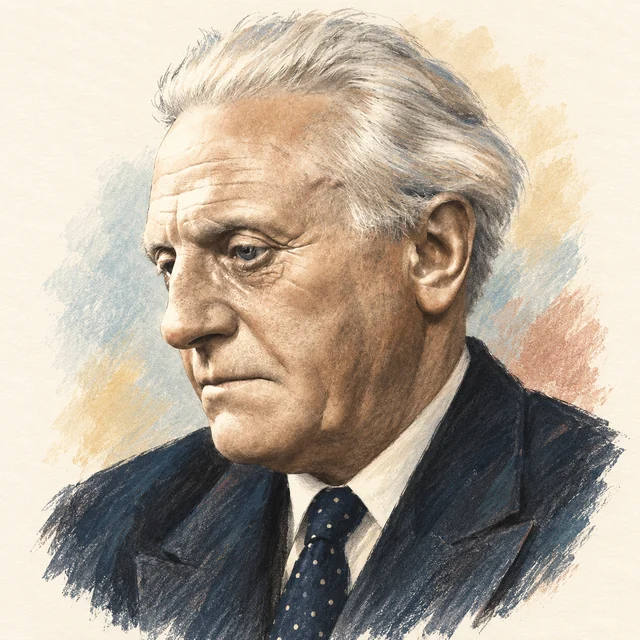
A life in context
The person behind the prize
Lagerkvist grew up in Växjö in a religious household. After a year at Uppsala he left university and travelled to Paris in 1913, encountering modern visual art. His 1913 essay Ordkonst och bildkonst challenged literary conventions, and Ångest in 1916 gave poetic form to anguish in an unsettled age. He worked across poems, plays and prose, returning to belief, doubt, cruelty and human dignity. Bödeln appeared in 1933, Dvärgen in 1944 and Barabbas in 1950. He became a member of the Swedish Academy in 1940. The 1951 award recognised his artistic force and independent engagement with enduring human questions across this body of work. It was not confined to a single novel or to religious affirmation. Sibyllan, published in 1956, belongs to his later writing and was not already available when he received the prize.
The contribution
Lagerkvist explored enduring questions of belief, suffering and human worth through forceful, independent literary work. He received the full Literature Prize.
The idea in plain language
How can literary form confront fear, cruelty and the search for meaning without reducing them to a ready answer? Lagerkvist’s writing moved among lyric poetry, drama and prose. His 1913 manifesto drew on encounters with modern art; Ångest in 1916 made anguish a central poetic subject in an age of upheaval.
Read the full award story ↗

