A life in context
The person behind the prize
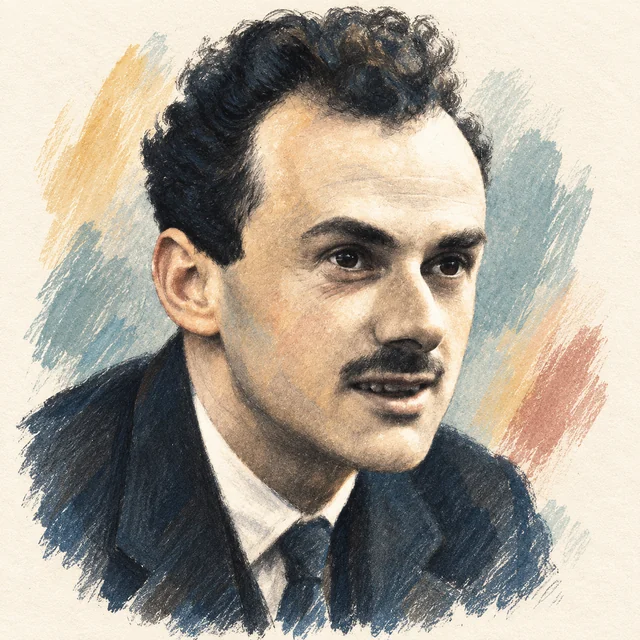
Dirac first trained in engineering at Bristol, graduating in 1921, then studied mathematics before moving to Cambridge. He completed his doctorate in 1926 and became a fellow of St John’s College in 1927. His early research helped formulate quantum mechanics in a general mathematical language. In 1928 he developed a relativistic electron equation that incorporated spin without treating the electron as a small rotating ball. Interpreting its solutions took further work: in 1931 he proposed an anti-electron with the electron’s mass and opposite electric charge. Anderson’s experimental discovery of the positron followed in 1932. Dirac became Cambridge’s Lucasian Professor in 1932 and shared the 1933 Physics Prize equally with Schrödinger. His book The Principles of Quantum Mechanics, first published in 1930, helped shape how generations of physicists learned the subject. The prize recognized theoretical development rather than the experimental detection of the positron.
The contribution
Dirac received half the Physics Prize for developing a productive form of atomic theory. His relativistic treatment of the electron brought quantum mechanics and special relativity together and led, through further interpretation, to the anti-electron prediction.
The idea in plain language
A classical picture of electrons circling a nucleus could not adequately explain atomic behaviour. In 1926 Schrödinger developed a wave equation whose solutions describe quantum states. For a bound system, the allowed solutions give particular energy values, helping explain why atomic spectra contain distinct lines. The wavefunction is a mathematical description; its squared magnitude determines position probabilities in the appropriate representation. It is not a photograph of an electron stretched into water waves.
Read the full award story ↗