A life in context
The person behind the prize
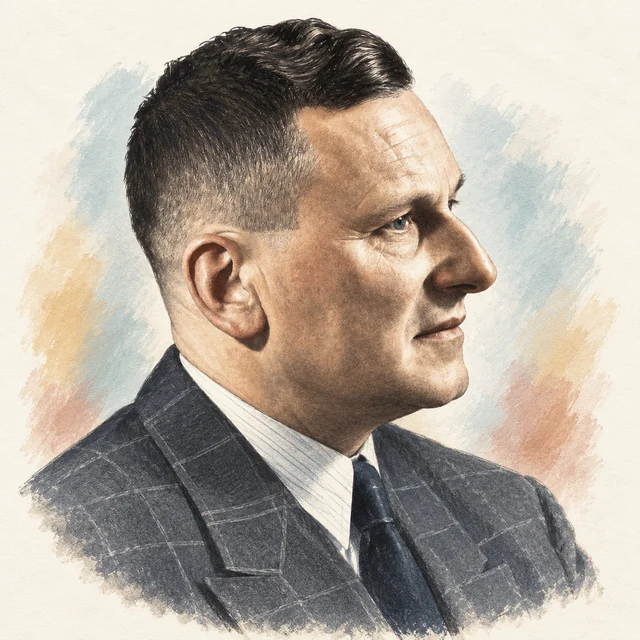
Müller began laboratory work in 1916 and joined Lonza as an assistant chemist the following year. After returning to school, he studied chemistry at Basel with Fichter and Rupe and obtained his doctorate in 1925. He joined J. R. Geigy in Basel that May. Research on dyes, tanning agents and crop protection led him to investigate synthetic contact insecticides from 1935. In 1939 he recognised the strong insecticidal action of DDT, a compound that had already been synthesised long before. A Swiss patent followed in 1940, and commercial formulations appeared in 1942; these dates describe different stages of the work. Müller became deputy director of plant-protection research in 1946. He received the full 1948 Medicine Prize as an industrial chemist, with Geigy as his affiliation. DDT helped control insects carrying malaria and epidemic typhus, but it also persisted in the environment, accumulated in organisms and harmed wildlife. This later history is essential context for the award. He is a different person from the 1946 laureate Hermann Joseph Muller.
The contribution
Müller discovered DDT’s strong action as a contact insecticide against several arthropods. The Medicine Prize recognised its historical importance for vector control; it did not establish harmlessness or a direct cure for human disease.
The idea in plain language
Could controlling an insect reduce the transmission of a disease it carries? Müller’s 1939 discovery showed that DDT, an already known chemical compound, acted strongly as a contact insecticide against several arthropods. The distinction matters: he discovered its insecticidal properties, rather than first synthesising the substance. The Swiss patent in 1940 and marketed formulations in 1942 were later stages.
Read the full award story ↗

