c.curionodeThe Nobel Archive

1948 · Physiology or Medicine

An insecticide’s benefits and lasting environmental costs

Müller’s discovery of DDT’s strong contact action helped control disease-carrying insects. Its persistence, insect resistance and ecological harms belong in the same historical account.

DDTDisease vectorsPersistenceEcological harms
1948Physiology or Medicine

Visual guide

The prize, pictured

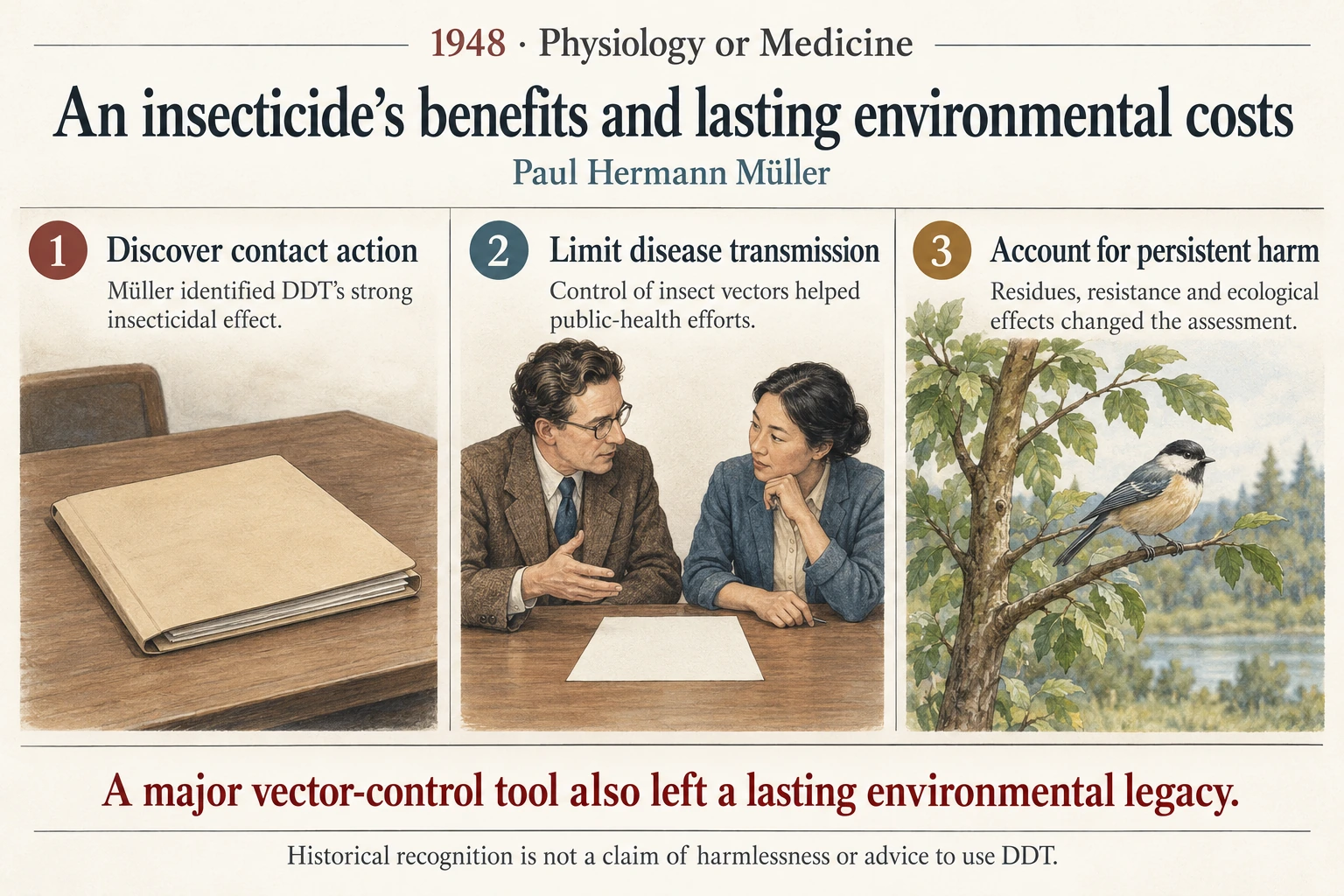
Infographic explaining An insecticide’s benefits and lasting environmental costs
Original AI-generated infographic. A conceptual overview; the explanations and sources below provide context.
Read the poster text

A major vector-control tool also left a lasting environmental legacy.

  1. Discover contact action

    Müller identified DDT’s strong insecticidal effect.

  2. Limit disease transmission

    Control of insect vectors helped public-health efforts.

  3. Account for persistent harm

    Residues, resistance and ecological effects changed the assessment.

Historical recognition is not a claim of harmlessness or advice to use DDT.

01 · The discovery

The idea, in everyday language

Could controlling an insect reduce the transmission of a disease it carries? Müller’s 1939 discovery showed that DDT, an already known chemical compound, acted strongly as a contact insecticide against several arthropods. The distinction matters: he discovered its insecticidal properties, rather than first synthesising the substance. The Swiss patent in 1940 and marketed formulations in 1942 were later stages.

DDT became important in programmes against insects carrying malaria and epidemic typhus, alongside other public-health efforts. It did not directly cure the diseases in people. The same persistence that made it attractive for insect control became a major problem: residues remained in the environment and accumulated in organisms. Research connected DDT’s breakdown product DDE with eggshell thinning and impaired reproduction in affected birds. Insect resistance also limited effectiveness.

Why it matters

The 1948 award recognised an important historical tool for controlling disease vectors, developed by an industrial chemist. The later environmental history also shows why immediate effectiveness is insufficient for evaluating a widely used chemical. Effects on ecosystems, exposure beyond the target and changing resistance must remain visible.


02 · The people

Who brought the idea to life?

Illustrated portrait of Paul Hermann Müller

Paul Hermann Müller

Prize share · 1

Müller discovered DDT’s strong action as a contact insecticide against several arthropods. The Medicine Prize recognised its historical importance for vector control; it did not establish harmlessness or a direct cure for human disease.

Read the biography ↗

03 · Years in the making

The path here

  1. 1925

    Müller completes his chemistry doctorate and joins Geigy.

  2. 1935

    He begins research on synthetic contact insecticides.

  3. 1939

    He discovers DDT’s strong insecticidal action.

  4. 1940

    A basic Swiss patent is granted.

  5. 1942

    Commercial formulations appear.

  6. 1948

    He receives the Medicine Prize for the discovery of contact action against several arthropods.

  7. 1972

    The United States cancels remaining crop uses because of environmental and other concerns.

04 · Read further

From the original sources

Original explanations by Curionode, based on the official records below. Biographical details and affiliations refer to the award year.

  1. Official award summary nobelprize.org
  2. Award ceremony speech nobelprize.org
  3. EPA history: DDT’s 1939 discovery and later restrictions epa.gov
  4. EPA: persistence, resistance and environmental effects epa.gov
  5. EPA: DDE, eggshell thinning and reproductive harm epa.gov
  6. Official biography: Paul Hermann Müller nobelprize.org

More in Physiology or Medicine

Browse this subject ↗