c.curionodeThe Nobel Archive

1949 · Physiology or Medicine

Two contributions, very different legacies

Hess’s research on bodily coordination and Moniz’s leucotomy received separate halves of the prize. The latter’s serious lasting harms are essential to the historical account.

DiencephalonLeucotomy historyLasting harmsPatient agency
1949Physiology or Medicine

Visual guide

The prize, pictured

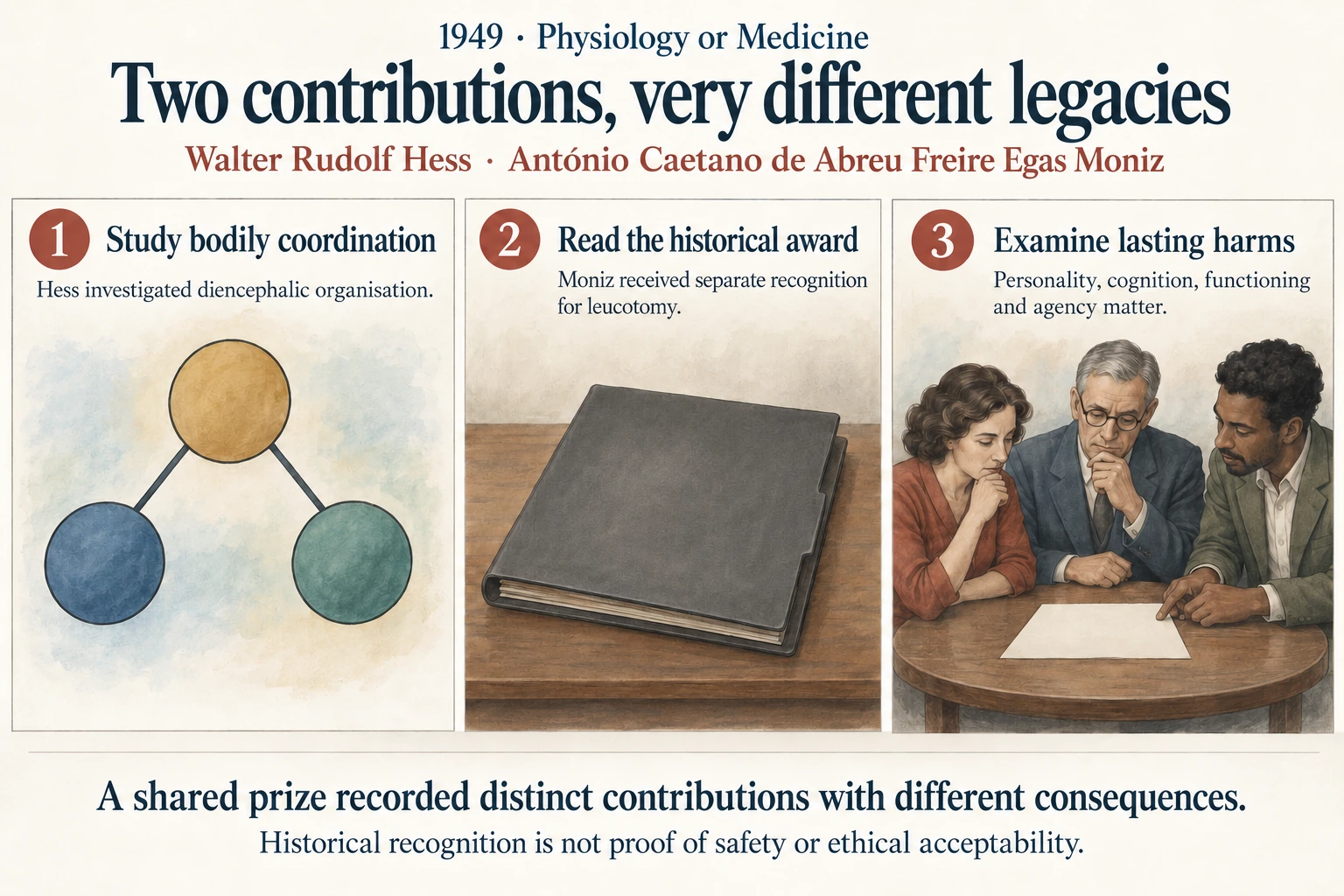
Infographic explaining Two contributions, very different legacies
Original AI-generated infographic. A conceptual overview; the explanations and sources below provide context.
Read the poster text

A shared prize recorded distinct contributions with different consequences.

  1. Study bodily coordination

    Hess investigated diencephalic organisation.

  2. Read the historical award

    Moniz received separate recognition for leucotomy.

  3. Examine lasting harms

    Personality, cognition, functioning and agency matter.

Historical recognition is not proof of safety or ethical acceptability.

01 · The discovery

The idea, in everyday language

How does the brain coordinate internal organs with the state of the whole body? Hess studied this question through animal physiology. His work identified functional organisation in the diencephalon, especially the hypothalamus, linking autonomic responses with coordinated patterns such as rest and defence. This was a contribution to understanding regulation, not the discovery of a single switch for every human emotion.

The other half went to Moniz for the committee’s 1949 assessment of leucotomy in certain psychiatric illnesses. Moniz and Almeida Lima had introduced this irreversible intervention in 1935. Historical claims of benefit must be read alongside serious changes to personality, cognition and everyday functioning, as well as epilepsy and other complications. A 1967 follow-up reported lasting harms in a selected historical cohort. Calmer behaviour or hospital discharge is not, by itself, evidence of restored wellbeing. These were separate contributions with different methods and consequences.

Why it matters

Hess’s work advanced understanding of autonomic coordination. The history of leucotomy also shows why long-term functioning, the person’s own experience, consent and agency matter when evaluating interventions. Neither a prestigious award nor a report of reduced symptoms settles those questions.
02 · The people

Who brought the idea to life?

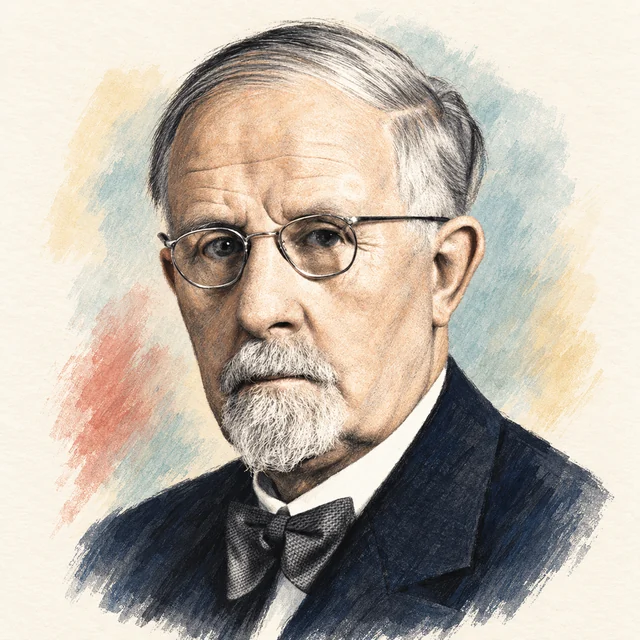
Illustrated portrait of Walter Rudolf Hess

Walter Rudolf Hess

Prize share · 1/2

Hess demonstrated functional organisation in the diencephalon as a coordinator of internal-organ activities. His half of the prize concerned animal physiology, separate from Moniz’s historical surgical award.

Read the biography ↗

03 · Years in the making

The path here

  1. 1906

    Hess qualifies in medicine at Zurich.

  2. 1911

    Moniz takes the neurology chair at Lisbon.

  3. 1917

    Hess becomes professor and director of Zurich’s physiological institute.

  4. 1935

    Moniz and Almeida Lima introduce leucotomy; a report follows in 1936.

  5. 1949

    Hess and Moniz each receive one half of the Medicine Prize for distinct contributions.

  6. 1967

    A historical follow-up reports lasting personality and functional problems and other complications in a selected operated cohort.

04 · Read further

From the original sources

Original explanations by Curionode, based on the official records below. Biographical details and affiliations refer to the award year.

  1. Official award summary nobelprize.org
  2. Award ceremony speech nobelprize.org
  3. Nobel history: leucotomy and its consequences (1998) nobelprize.org
  4. Historical follow-up: publication record and abstract (1967) pmc.ncbi.nlm.nih.gov
  5. Official biography: Walter Rudolf Hess nobelprize.org
  6. Official biography: António Caetano de Abreu Freire Egas Moniz nobelprize.org

More in Physiology or Medicine

Browse this subject ↗