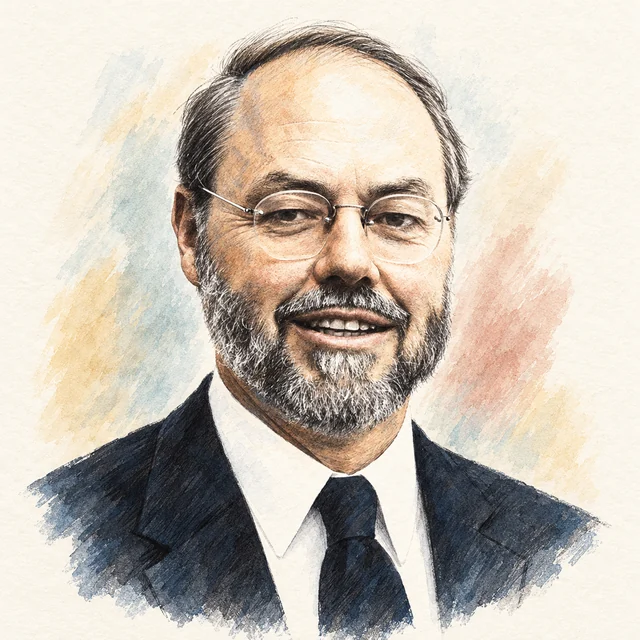
A life in context
The person behind the prize
Sharp grew up on a Kentucky family farm and studied chemistry and mathematics at Union College before doctoral work in Illinois. At Caltech, new methods of electron microscopy drew him into molecular biology. Research at Cold Spring Harbor preceded his move to MIT in 1974. His adenovirus work asked how nuclear RNA related to the shorter messages found in the cell’s cytoplasm.
The contribution
Sharp’s laboratory, including Susan Berget and collaborators, compared adenovirus messenger RNA with the DNA that encoded it. Their 1977 experiments showed that the message joined sequences separated in the genome, independently of Roberts’s group. This supported a model in which a longer RNA precursor is processed by removing intervening RNA and joining retained segments. The prize recognised split genes, not the claim that every gene must contain introns.
The idea in plain language
A simple view of a gene treated its message as the copy of one uninterrupted DNA segment. In 1977, Roberts’s and Sharp’s groups independently found a different arrangement in adenovirus. A mature messenger RNA matched several separated DNA regions. In RNA–DNA hybrids, intervening DNA formed loops because those stretches had no counterpart in the mature message.
Read the full award story ↗