A life in context
The person behind the prize
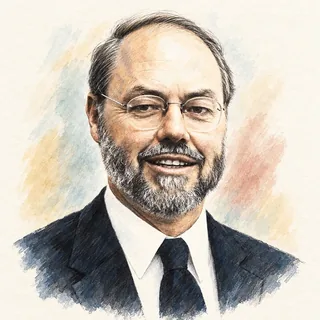
Roberts grew up in Bath after an early move from Derby. Mathematical puzzles and a home chemistry laboratory encouraged his scientific interests. Chemistry training and postdoctoral work led to molecular biology at Cold Spring Harbor, which he joined in 1972. His laboratory studied restriction enzymes and adenovirus RNA. In 1992 he moved to New England Biolabs, his affiliation at the award.
The contribution
Roberts’s group found that parts of an adenovirus messenger RNA came from separated stretches of viral DNA. Biochemical clues and electron microscopy, with collaborators including Richard Gelinas, Louise Chow and Tom Broker, established the discontinuous arrangement in 1977. Sharp’s group independently reached the same central result. The discovery challenged the assumption that a gene’s expressed sequence was always one uninterrupted DNA stretch, revealing the need for RNA splicing.
The idea in plain language
A simple view of a gene treated its message as the copy of one uninterrupted DNA segment. In 1977, Roberts’s and Sharp’s groups independently found a different arrangement in adenovirus. A mature messenger RNA matched several separated DNA regions. In RNA–DNA hybrids, intervening DNA formed loops because those stretches had no counterpart in the mature message.
Read the full award story ↗