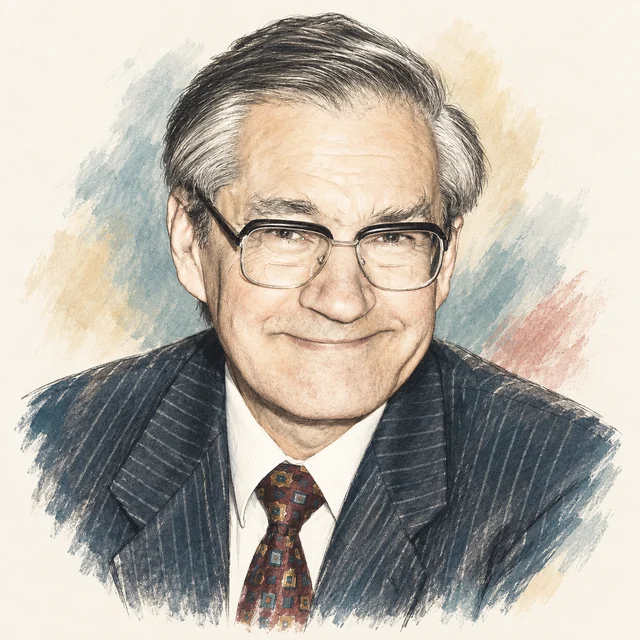
A life in context
The person behind the prize
Ernst grew up in Winterthur, enjoying music and chemistry, and studied at ETH Zurich. His doctoral work, completed in 1962, combined instrumentation with theory. At Varian in California he worked with Weston Anderson on pulse-based Fourier-transform NMR. Returning to Zurich in 1968, he developed a research group that helped turn multidimensional NMR into a versatile analytical method. His autobiography stresses the contributions of students, collaborators and competing laboratories.
The contribution
Ernst developed methods that greatly improved nuclear magnetic resonance spectroscopy. With Anderson he developed pulse excitation and Fourier analysis to acquire many resonance frequencies together. Later work developed two-dimensional spectroscopy from a proposal by Jean Jeener, separating overlapping signals and relating resonances. These spectra support deductions about molecules; they are not direct photographs of atoms. Ernst received the whole Chemistry Prize for methodological contributions, rather than for discovering NMR itself.
The idea in plain language
Some atomic nuclei have spin and respond to radio-frequency excitation in a magnetic field. Their resonance signals depend on the surrounding chemical environment. Early spectroscopy could be slow and limited in sensitivity. Ernst and Weston Anderson developed pulse-based Fourier-transform NMR: a short pulse excites many resonances, and a decaying time signal is mathematically transformed into a spectrum of frequencies.
Read the full award story ↗

