c.curionodeThe Nobel Archive

1991 · Chemistry

Turn magnetic signals into molecular clues

Ernst’s methods made NMR more sensitive and enabled multidimensional spectra that reveal relationships within molecules.

NMRFourier transformspectroscopymolecular structure
1991Chemistry

Visual guide

The prize, pictured

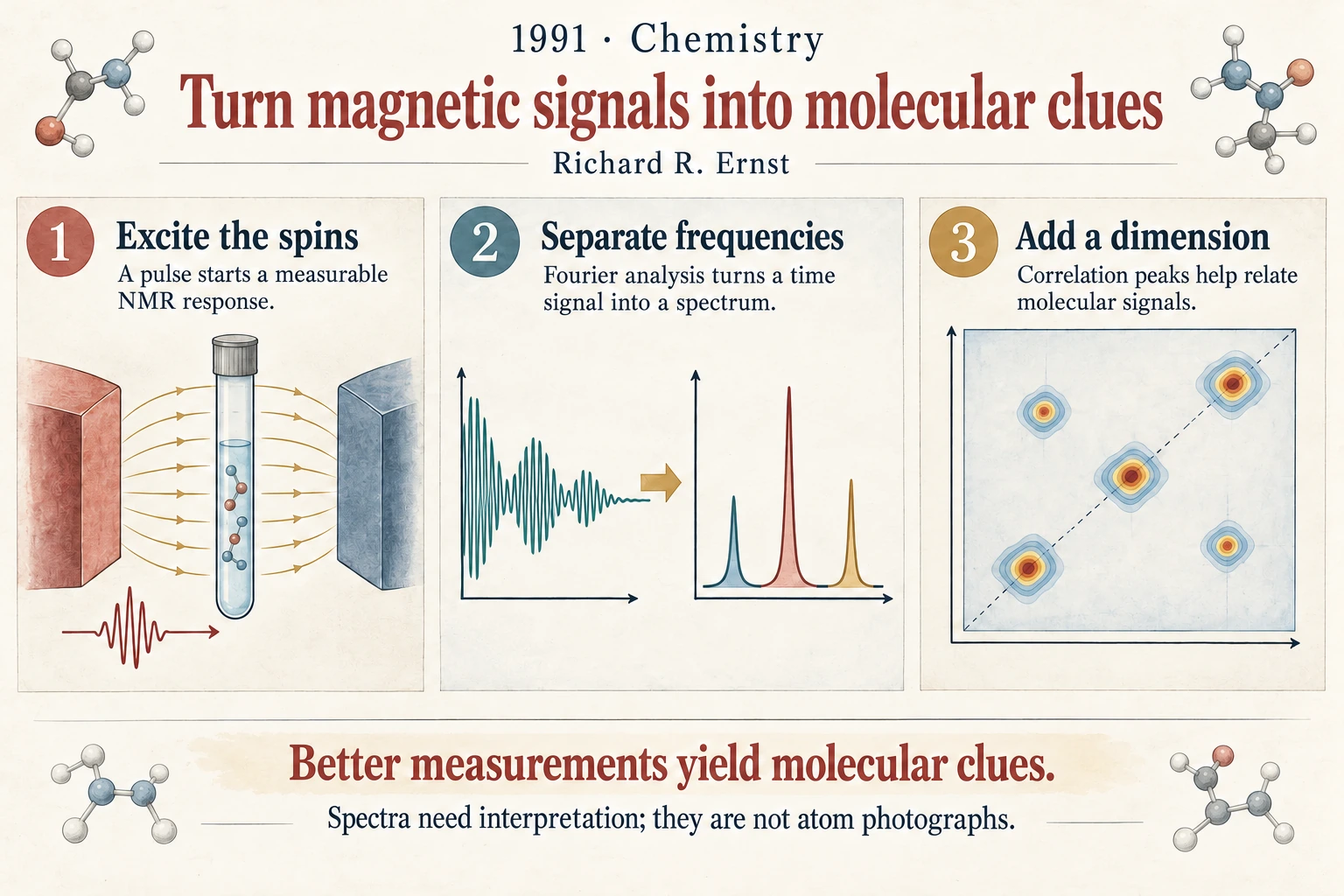
Infographic explaining Turn magnetic signals into molecular clues
Original AI-generated infographic. A conceptual overview; the explanations and sources below provide context.
Read the poster text

Better measurements yield molecular clues.

  1. Excite the spins

    A pulse starts a measurable NMR response.

  2. Separate frequencies

    Fourier analysis turns a time signal into a spectrum.

  3. Add a dimension

    Correlation peaks help relate molecular signals.

Spectra need interpretation; they are not atom photographs.

01 · The discovery

The idea, in everyday language

Some atomic nuclei have spin and respond to radio-frequency excitation in a magnetic field. Their resonance signals depend on the surrounding chemical environment. Early spectroscopy could be slow and limited in sensitivity. Ernst and Weston Anderson developed pulse-based Fourier-transform NMR: a short pulse excites many resonances, and a decaying time signal is mathematically transformed into a spectrum of frequencies.

Building on Jean Jeener’s proposal, Ernst and collaborators developed two-dimensional NMR. Experiments vary one time interval and record another, then use Fourier analysis in both dimensions. A spectrum with two frequency axes separates overlapping information; correlation peaks connect resonances through the particular experiment’s interactions. Together with analysis and other evidence, these measurements help infer molecular structure and motion.

Why it matters

Pulse Fourier methods made efficient data collection and signal averaging possible. Multidimensional methods greatly expanded chemical analysis and the study of biological molecules in solution. Their structural information contributed to a broader field of spectroscopy and collaborators’ work; a spectrum is evidence used to build a molecular model.

02 · The people

Who brought the idea to life?

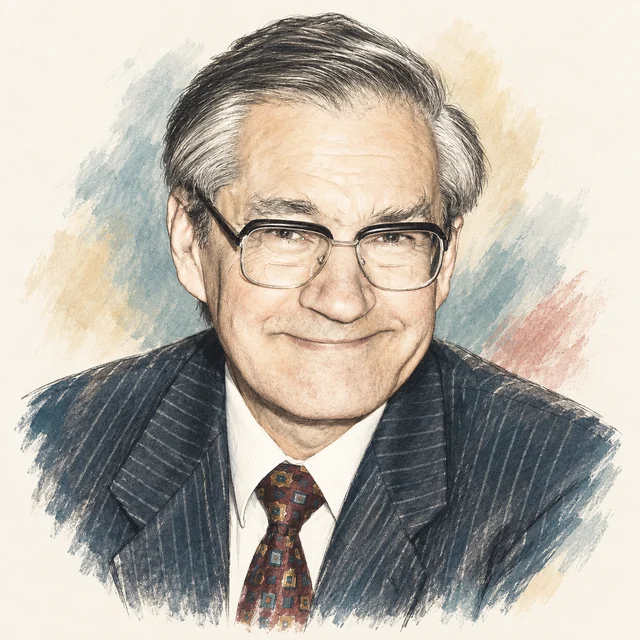
Illustrated portrait of Richard R. Ernst

Richard R. Ernst

Prize share · 1

Ernst developed methods that greatly improved nuclear magnetic resonance spectroscopy. With Anderson he developed pulse excitation and Fourier analysis to acquire many resonance frequencies together. Later work developed two-dimensional spectroscopy from a proposal by Jean Jeener, separating overlapping signals and relating resonances. These spectra support deductions about molecules; they are not direct photographs of atoms. Ernst received the whole Chemistry Prize for methodological contributions, rather than for discovering NMR itself.

Read the biography ↗

03 · Years in the making

The path here

  1. 1966

    Ernst and Anderson publish the pulse Fourier-transform NMR method.

  2. 1971

    Jean Jeener proposes the two-dimensional spectroscopy approach.

  3. 1975–1976

    Ernst and colleagues develop and report two-dimensional NMR methods.

  4. 1991

    The Chemistry Prize recognises Ernst’s NMR methodological contributions.

04 · Read further

From the original sources

Original explanations by Curionode, based on the official records below. Biographical details and affiliations refer to the award year.

  1. Official announcement nobelprize.org

More in Chemistry

Browse this subject ↗