c.curionodeThe Nobel Archive

1992 · Chemistry

The surroundings help an electron move

Marcus related electron-transfer rates to molecular rearrangement and the reaction’s driving force.

electron transferreorganisation energyreaction ratesinverted region
1992Chemistry

Visual guide

The prize, pictured

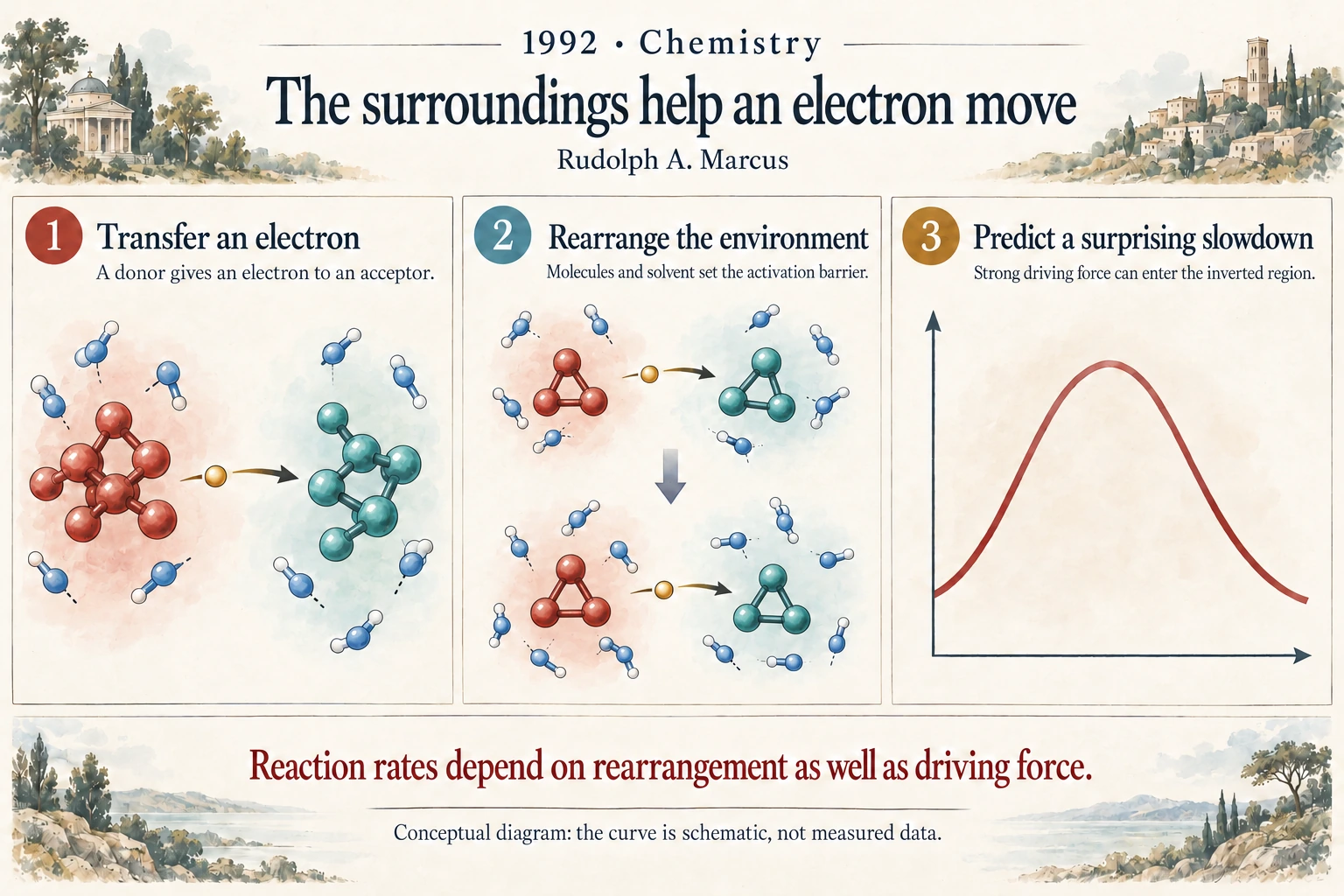
Infographic explaining The surroundings help an electron move
Original AI-generated infographic. A conceptual overview; the explanations and sources below provide context.
Read the poster text

Reaction rates depend on rearrangement as well as driving force.

  1. Transfer an electron

    A donor gives an electron to an acceptor.

  2. Rearrange the environment

    Molecules and solvent set the activation barrier.

  3. Predict a surprising slowdown

    Strong driving force can enter the inverted region.

Conceptual diagram: the curve is schematic, not measured data.

01 · The discovery

The idea, in everyday language

Transferring one electron can look like a tiny change, yet some electron-transfer reactions are fast and others slow. Marcus explained that the reacting molecules and their surroundings must rearrange. The solvent responds to changed charge, while molecular bond lengths and other internal coordinates can also change. Reaching a suitable configuration creates an activation barrier.

His theory related that barrier to reorganisation energy and the reaction’s free-energy change. It predicted an initially surprising possibility: increasing the driving force can first speed transfer, then slow it in the inverted region. Experiments eventually supported that prediction. The result connects chemical rate to the whole molecular environment rather than treating the electron as an isolated object making an effortless jump.

Why it matters

Electron transfer underlies redox chemistry, electrochemistry and important steps in photosynthesis. Marcus’s theory gave researchers a way to connect measured rates with molecular structure and environment, and to test explanations of chemical dynamics. It also showed how a counterintuitive theoretical prediction could motivate demanding experiments.
02 · The people

Who brought the idea to life?

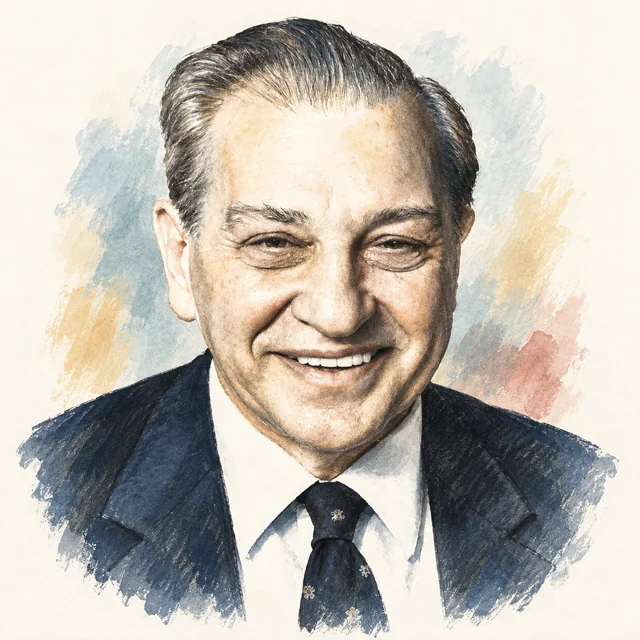
Illustrated portrait of Rudolph A. Marcus

Rudolph A. Marcus

Prize share · 1

Marcus explained how the rearrangement of reacting molecules and their surroundings sets an activation barrier for electron transfer. Work from 1956 to 1965 related reaction rate to reorganisation and free-energy change. It also predicted an inverted region: under appropriate conditions, a stronger thermodynamic driving force can slow the reaction. This is a theory of specified electron-transfer processes, not a universal claim that greater energy always makes chemistry slower.

Read the biography ↗

03 · Years in the making

The path here

  1. 1956

    Marcus begins publishing the theoretical account of electron transfer.

  2. 1965

    The theory develops the relation between driving force and transfer rate.

  3. Late 1980s

    Experimental studies support the predicted inverted-region behaviour.

  4. 1992

    The Chemistry Prize recognises contributions to electron-transfer theory.

04 · Read further

From the original sources

Original explanations by Curionode, based on the official records below. Biographical details and affiliations refer to the award year.

  1. Official announcement nobelprize.org

More in Chemistry

Browse this subject ↗