c.curionodeThe Nobel Archive

1994 · Chemistry

Making fleeting ions observable

Olah created conditions in which reactive carbon-containing cations could survive long enough for detailed study.

carbocationssuperacidsreaction intermediatesmolecular bonding
1994Chemistry

Visual guide

The prize, pictured

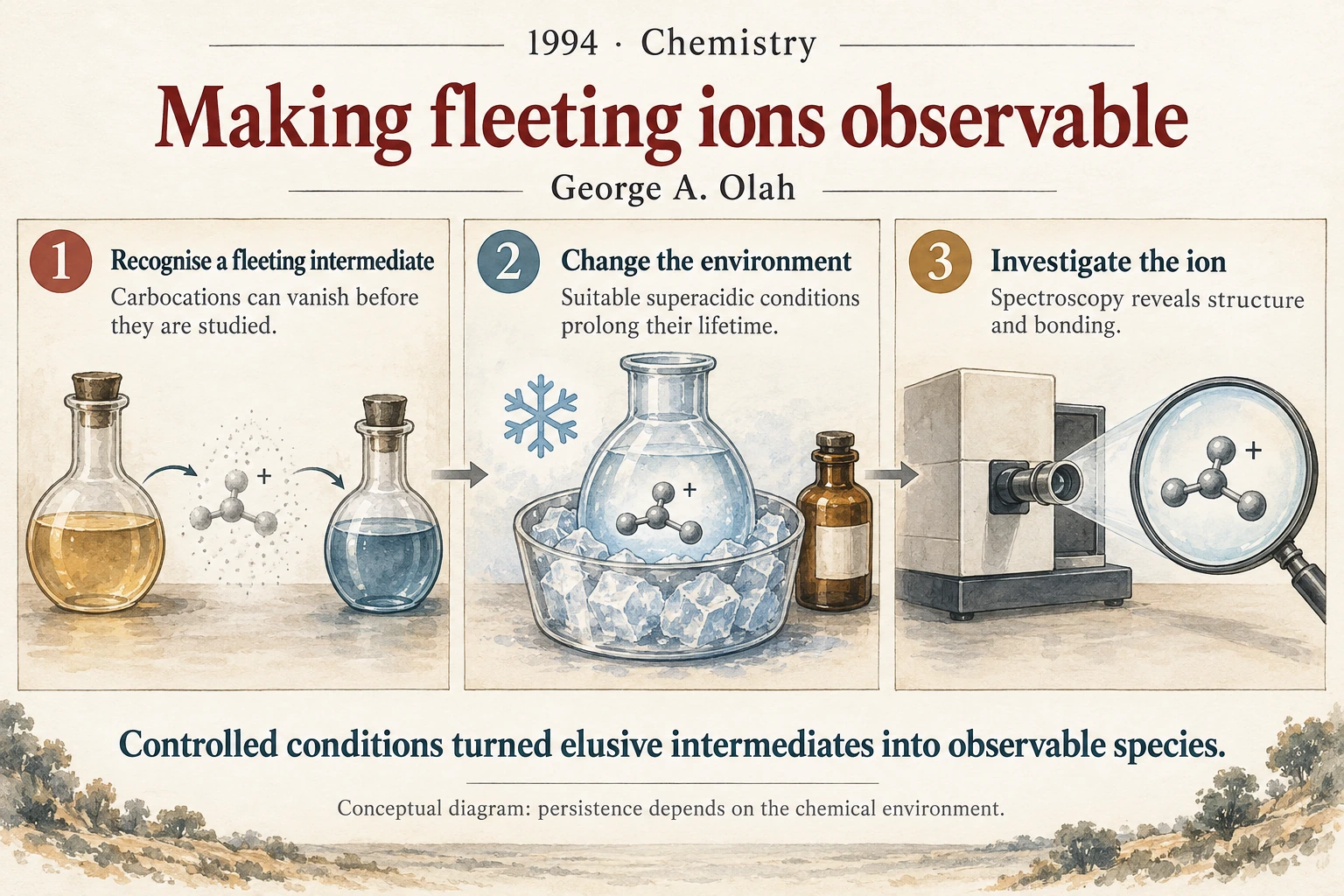
Infographic explaining Making fleeting ions observable
Original AI-generated infographic. A conceptual overview; the explanations and sources below provide context.
Read the poster text

Controlled conditions turned elusive intermediates into observable species.

  1. Recognise a fleeting intermediate

    Carbocations can vanish before they are studied.

  2. Change the environment

    Suitable superacidic conditions prolong their lifetime.

  3. Investigate the ion

    Spectroscopy reveals structure and bonding.

Conceptual diagram: persistence depends on the chemical environment.

01 · The discovery

The idea, in everyday language

A chemical reaction can pass through intermediate species that vanish before ordinary instruments can examine them. Carbocations are positively charged carbon-containing species important in many organic reactions. Their existence had been inferred from reaction behaviour, but their short lifetimes made their structure and bonding difficult to test directly.

Olah and collaborators changed the experimental conditions. Superacids helped generate the ions, while weakly nucleophilic media and low temperatures limited reactions that would quickly consume them. With sufficient lifetimes and concentrations, spectroscopy could investigate the ions themselves. This approach exposed a wide variety of structures, including nonclassical ions in which bonding and charge are shared in ways a simple localised picture misses.

Why it matters

The work strengthened understanding of organic reaction mechanisms and the bonding of carbocations. It also enabled new transformations of hydrocarbons, including rearrangements and catalytic processes. The practical importance comes from linking what an intermediate is to how a reaction proceeds, rather than treating it as a hypothetical step that cannot be examined.
02 · The people

Who brought the idea to life?

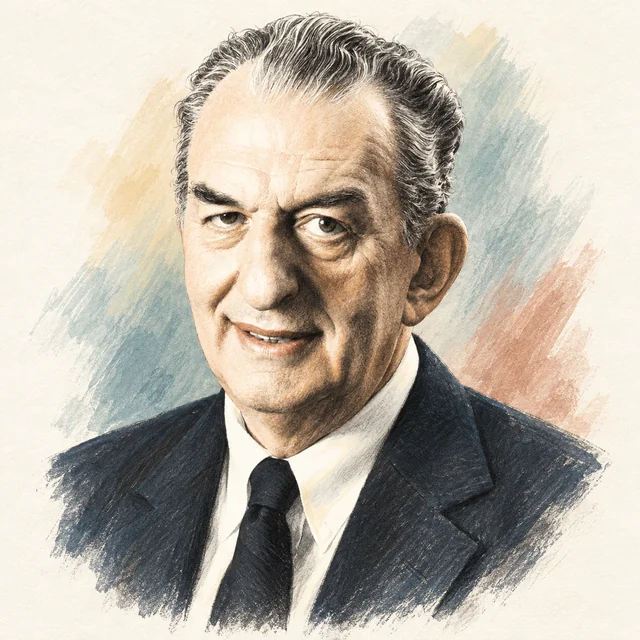
Illustrated portrait of George A. Olah

George A. Olah

Prize share · 1

Olah and collaborators used very strong acids, suitable weakly nucleophilic media and low temperatures to produce carbocations with lifetimes and concentrations sufficient for spectroscopy. This made it possible to investigate their structure, bonding and reactivity, including nonclassical ions with shared bonding. He did not invent the idea of carbocations; he changed how chemists could observe and test it, and developed related reactions in hydrocarbon chemistry.

Read the biography ↗

03 · Years in the making

The path here

  1. 1920s–1930s

    Studies of organic reaction mechanisms suggest carbocation intermediates.

  2. Early 1960s

    Olah and collaborators prepare persistent carbocations under superacidic conditions.

  3. 1977

    Olah moves to Southern California and develops a hydrocarbon research institute.

  4. 1994

    The Chemistry Prize recognises his contribution to carbocation chemistry.

04 · Read further

From the original sources

Original explanations by Curionode, based on the official records below. Biographical details and affiliations refer to the award year.

  1. Official announcement nobelprize.org

More in Chemistry

Browse this subject ↗