c.curionodeThe Nobel Archive

1993 · Chemistry

Copy DNA, change DNA

PCR amplified selected DNA, while site-directed mutagenesis made chosen sequence changes into experimental tools.

PCRsite-directed mutagenesisDNA methodsprotein function
1993Chemistry

Visual guide

The prize, pictured

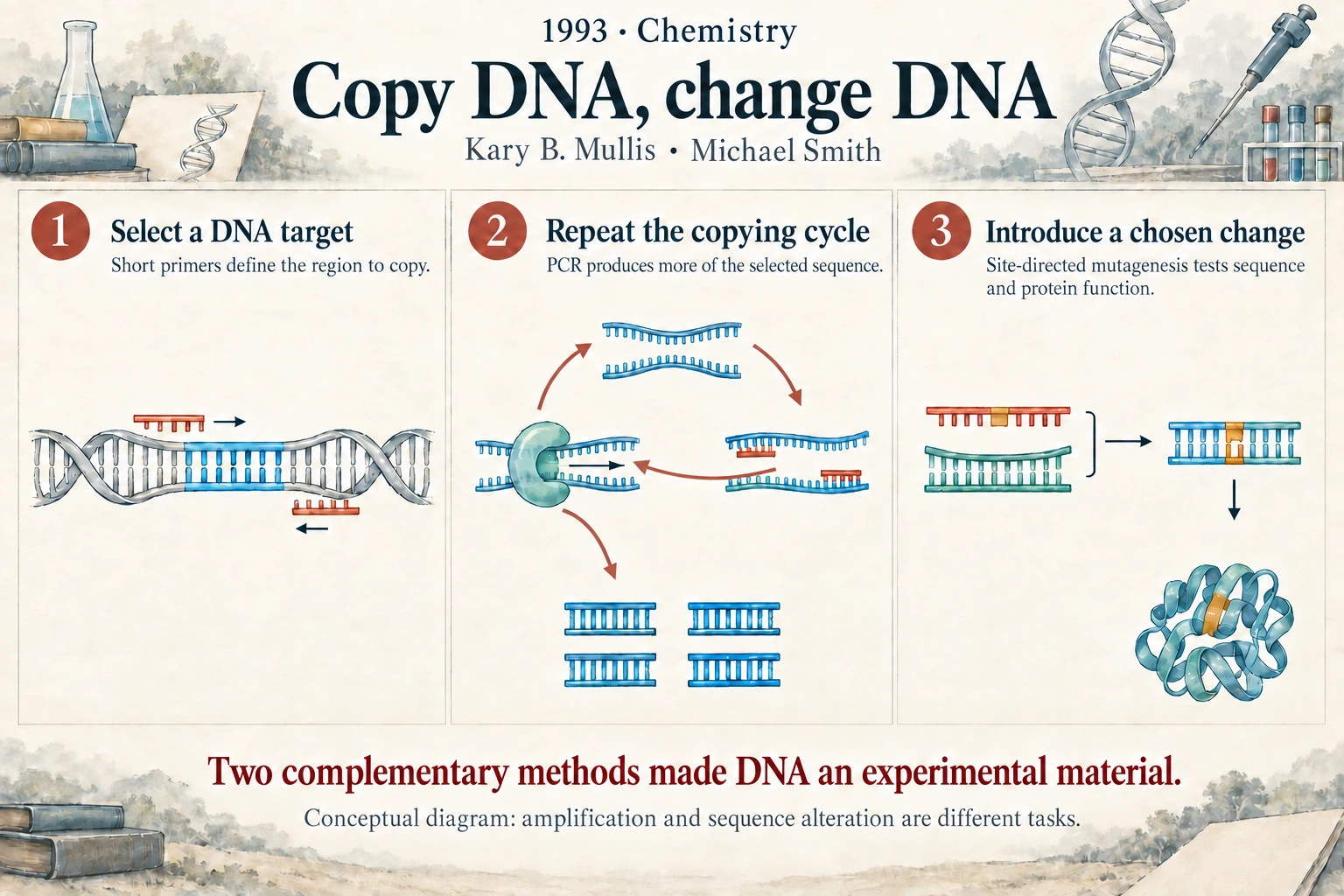
Infographic explaining Copy DNA, change DNA
Original AI-generated infographic. A conceptual overview; the explanations and sources below provide context.
Read the poster text

Two complementary methods made DNA an experimental material.

  1. Select a DNA target

    Short primers define the region to copy.

  2. Repeat the copying cycle

    PCR produces more of the selected sequence.

  3. Introduce a chosen change

    Site-directed mutagenesis tests sequence and protein function.

Conceptual diagram: amplification and sequence alteration are different tasks.

01 · The discovery

The idea, in everyday language

A useful DNA sample can be too scarce to analyse, and a protein’s function can be hard to explain without changing its instructions. The 1993 prize recognised two methods addressing those different problems. Mullis’s PCR uses two short primers to select a DNA region, separates strands with heat, and uses a polymerase to make new strands. Repeated cycles let new products serve as templates for further copies.

Smith’s method uses a synthetic short DNA strand carrying an intended sequence difference. It can still pair with a suitable template and direct production of DNA containing the chosen change. Expressing an altered gene then lets researchers investigate how a selected change affects a protein. Amplification increases material; mutagenesis changes a sequence. Neither operation by itself explains every consequence.

Why it matters

The methods transformed research on genes and proteins, enabling analysis from small DNA samples and controlled tests of molecular function. Their development involved collaborators and later improvements, including more practical PCR cycling. They became foundations for many laboratory applications rather than complete answers to every biological question.

02 · The people

Who brought the idea to life?

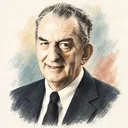
Illustrated portrait of Kary B. Mullis

Kary B. Mullis

Prize share · 1/2

Mullis conceived repeated rounds of primer-directed DNA synthesis so that products from one cycle could become templates for later cycles. This amplifies a selected DNA segment without first growing it in cells. The method emerged from laboratory development and was reported in 1985; colleagues and later improvements were essential to practical PCR. His half of the prize recognised PCR, while Smith’s half recognised deliberately changing DNA sequences.

Read the biography ↗
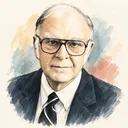
Illustrated portrait of Michael Smith

Michael Smith

Prize share · 1/2

Smith and colleagues used a synthetic short DNA strand carrying a chosen mismatch to direct a specific sequence change. Their 1978 experiments established a practical route to site-directed mutagenesis, and later protein studies tested what selected amino-acid replacements did. This turned mutation from something researchers merely observed into a controlled experimental question. It did not mean every change improves a protein or that a desired mutation is automatically a therapy.

Read the biography ↗

03 · Years in the making

The path here

  1. 1978

    Smith and colleagues demonstrate oligonucleotide-directed sequence changes.

  2. 1983

    Mullis conceives repeated primer-directed DNA amplification at Cetus.

  3. 1985

    PCR is reported as a practical laboratory method.

  4. 1993

    Mullis and Smith receive equal halves for distinct DNA-based methods.

04 · Read further

From the original sources

Original explanations by Curionode, based on the official records below. Biographical details and affiliations refer to the award year.

  1. Official announcement nobelprize.org
  2. NHGRI history of PCR genome.gov
  3. NHGRI explanation of PCR genome.gov

More in Chemistry

Browse this subject ↗