01 · The discovery
The idea, in everyday language
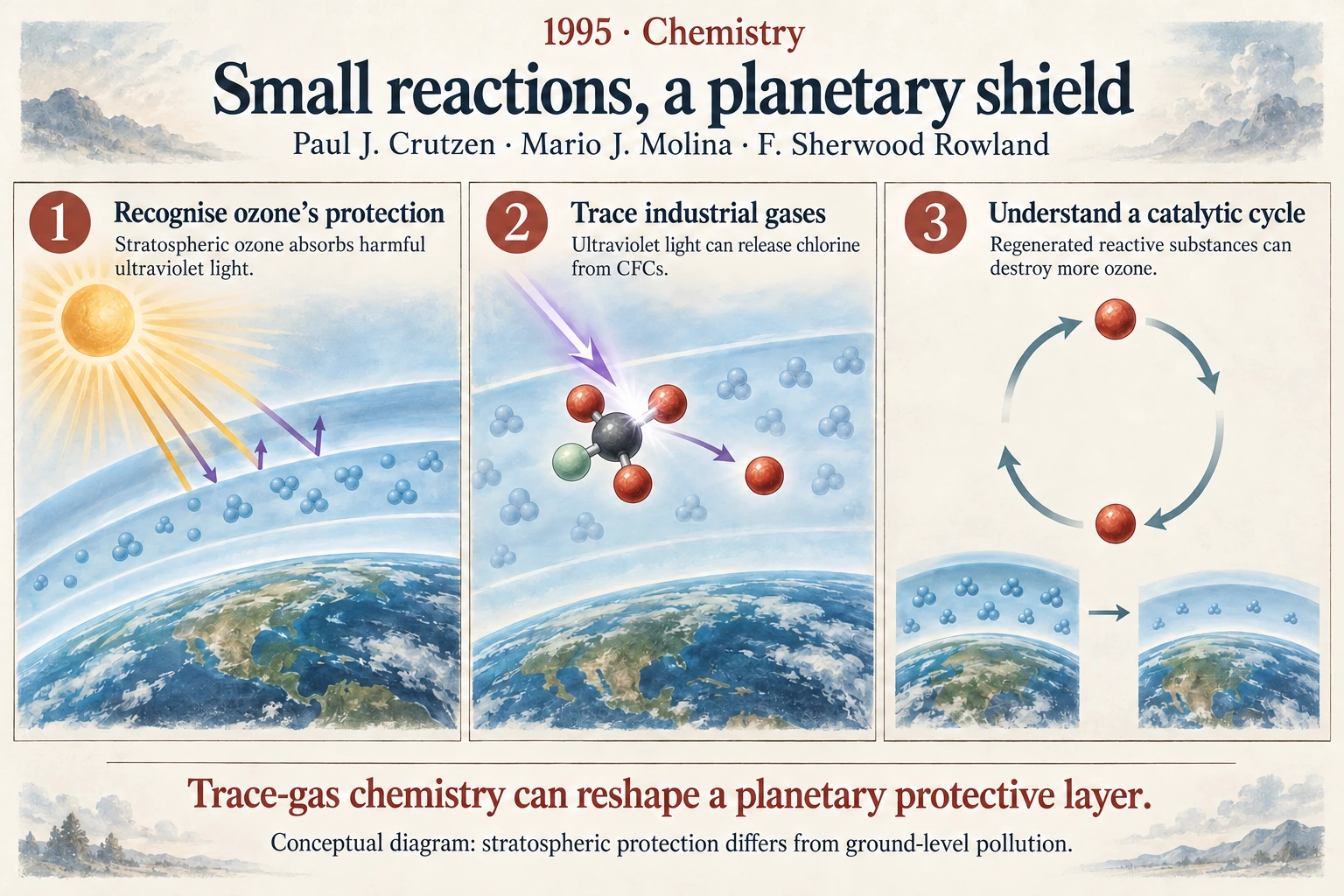
Ozone in the stratosphere absorbs much harmful ultraviolet radiation. Its amount depends on competing reactions that create and destroy it. Crutzen showed in 1970 how nitrogen oxides participate in catalytic ozone destruction: a reactive substance is regenerated and can repeat the process. Understanding these cycles made it possible to ask how small concentrations could have large consequences.
Molina and Rowland then investigated the fate of industrial chlorofluorocarbons. Their 1974 work showed why stability in the lower atmosphere was a problem: CFCs could persist, rise to the stratosphere and be broken apart by ultraviolet light, releasing chlorine that catalytically depleted ozone. Later measurements and research, including Antarctic ozone chemistry, connected molecular mechanisms to an environmental threat and strengthened the scientific basis for international controls.
Why it matters
The work helped transform ozone depletion into a problem that could be explained, measured and addressed through emissions controls. The 1987 Montreal Protocol emerged from international negotiations informed by a wider scientific effort. Long-lived gases and atmospheric transport mean that reducing emissions does not instantly restore the ozone layer.