A life in context
The person behind the prize
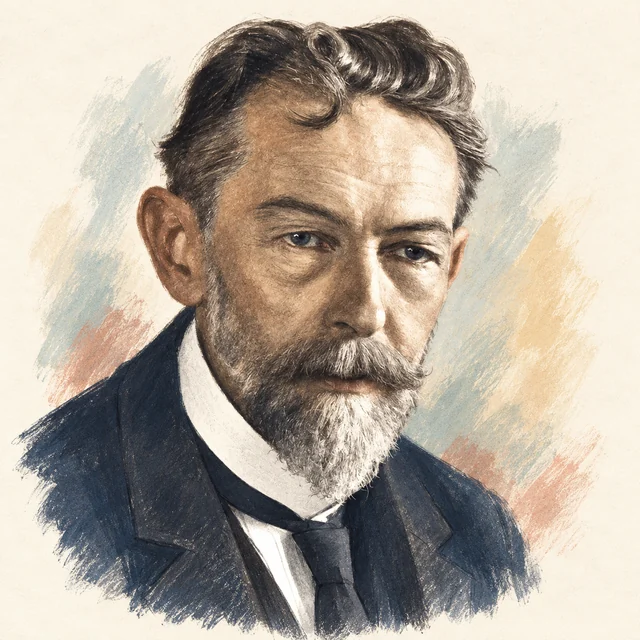
Zsigmondy grew up in Vienna in a family that encouraged natural science, outdoor pursuits and the arts. He studied chemistry in Vienna and Munich, then worked in Berlin and qualified as a lecturer in Graz in 1893. Research on colours in glass and ceramics drew him towards colloids: materials containing very small dispersed particles. He worked at the Schott glassworks in Jena before devoting himself to independent research in 1900. With the optician Siedentopf he developed the slit ultramicroscope, using light scattered from particles to reveal dispersions that looked uniform under ordinary observation. He also devised methods for studying gold colloids and investigated particle aggregation. Appointed to Göttingen in 1907, he remained there until retirement in 1929. His full 1925 Chemistry Prize was announced and presented in 1926, separately from Svedberg’s 1926 prize. The work demonstrated that apparent uniformity could conceal a dispersed particle structure; it did not provide ordinary photographs of individual molecules. Zsigmondy died in Göttingen in September 1929.
The contribution
Zsigmondy received the full Chemistry Prize for demonstrating the heterogeneous nature of colloidal solutions and developing fundamental methods for their study, including ultramicroscopy developed with Siedentopf.
The idea in plain language
A liquid can look uniform without being uniform at the scale of its dispersed particles. Researchers needed ways to distinguish a molecular solution from a colloidal dispersion. Work on coloured glass and gold colloids led Zsigmondy to methods for examining particles too small to see by ordinary microscopy.
Read the full award story ↗

