c.curionodeThe Nobel Archive

1925 · Chemistry

Clear-looking liquids can contain hidden particles

Zsigmondy developed methods that exposed the dispersed particles in colloids. Light scattering made a structure visible that ordinary observation could miss.

ColloidsUltramicroscopeLight scattering
1925Chemistry

Visual guide

The prize, pictured

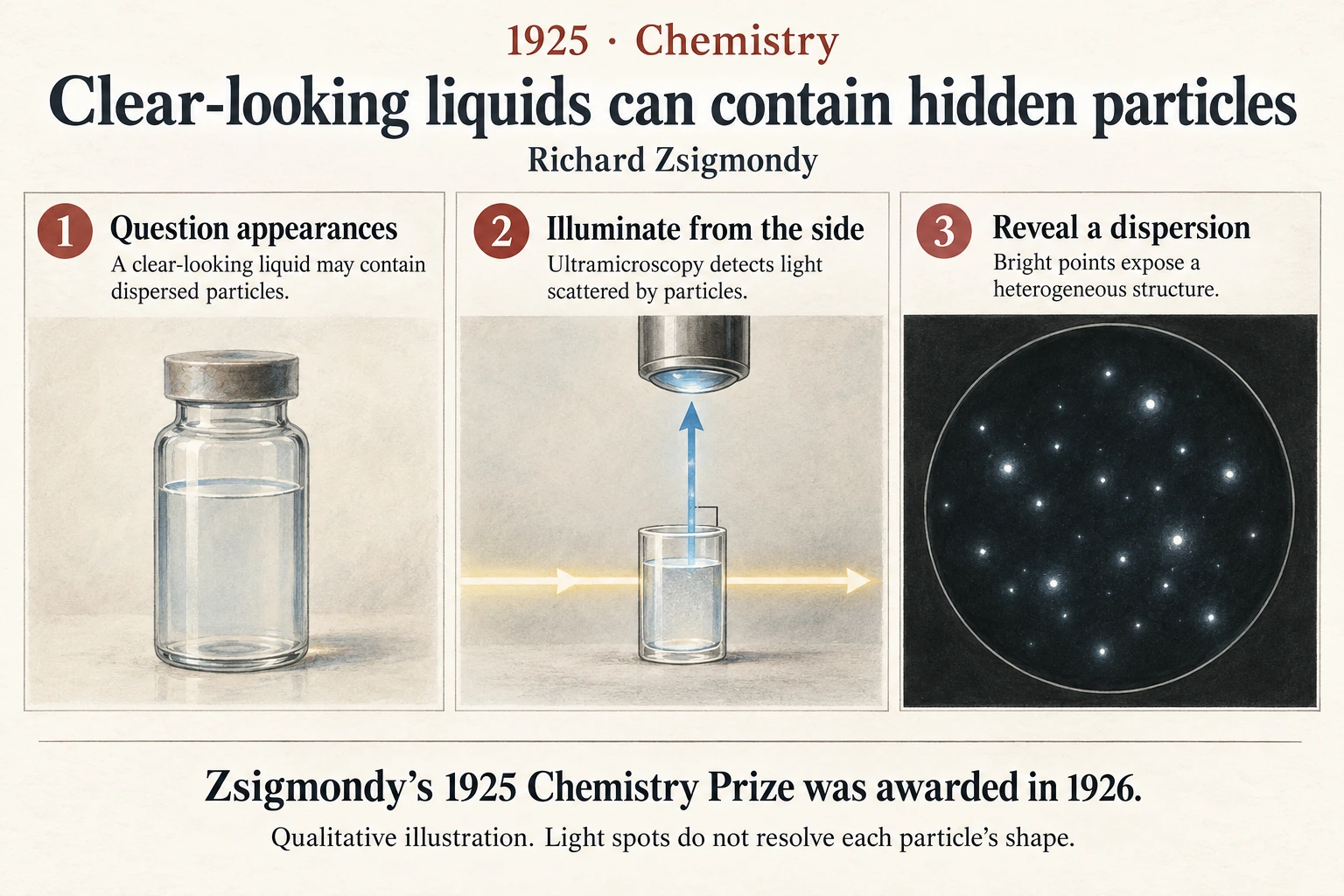
Infographic explaining Clear-looking liquids can contain hidden particles
Original AI-generated infographic. A conceptual overview; the explanations and sources below provide context.
Read the poster text

Zsigmondy’s 1925 Chemistry Prize was awarded in 1926.

  1. Question appearances

    A clear-looking liquid may contain dispersed particles.

  2. Illuminate from the side

    Ultramicroscopy detects light scattered by particles.

  3. Reveal a dispersion

    Bright points expose a heterogeneous structure.

Qualitative illustration. Light spots do not resolve each particle’s shape.

01 · The discovery

The idea, in everyday language

A liquid can look uniform without being uniform at the scale of its dispersed particles. Researchers needed ways to distinguish a molecular solution from a colloidal dispersion. Work on coloured glass and gold colloids led Zsigmondy to methods for examining particles too small to see by ordinary microscopy.

Working with Siedentopf, he developed ultramicroscopy: intense illumination enters from the side, while the sample is observed perpendicular to that beam. Scattered light makes tiny particles detectable as bright points against a darker background. His wider methods helped investigate particle numbers, size and aggregation, establishing the heterogeneous character of colloidal solutions.

Why it matters

The methods made colloids accessible to systematic observation and measurement. They helped replace arguments about apparently uniform liquids with experimental evidence about dispersed particles and their behaviour.

02 · The people

Who brought the idea to life?

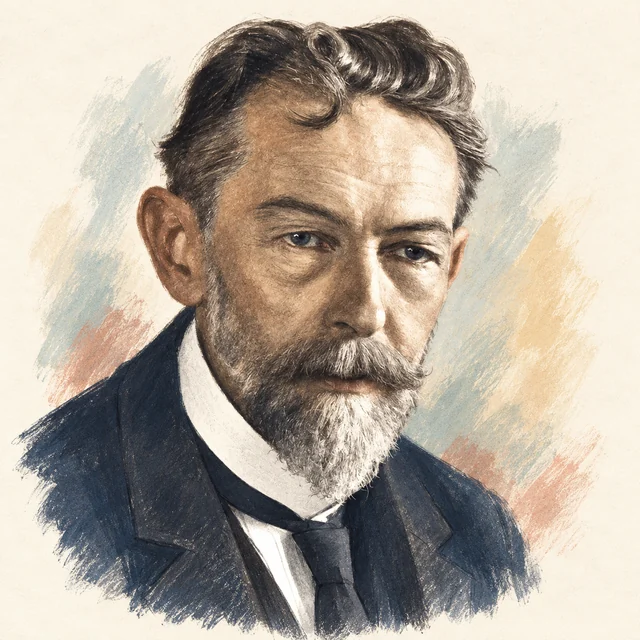
Illustrated portrait of Richard Zsigmondy

Richard Zsigmondy

Prize share · 1

Zsigmondy received the full Chemistry Prize for demonstrating the heterogeneous nature of colloidal solutions and developing fundamental methods for their study, including ultramicroscopy developed with Siedentopf.

Read the biography ↗

03 · Years in the making

The path here

  1. 1893

    Zsigmondy qualifies as a lecturer in Graz; glass-colour research leads towards colloids.

  2. 1902

    His idea for ultramicroscopy develops into an instrument with Siedentopf.

  3. 1907

    He becomes professor at Göttingen.

  4. 1926

    The reserved 1925 Chemistry Prize is announced and presented to Zsigmondy.

04 · Read further

From the original sources

Original explanations by Curionode, based on the official records below. Biographical details and affiliations refer to the award year.

  1. Official award summary nobelprize.org
  2. Award ceremony speech nobelprize.org

More in Chemistry

Browse this subject ↗