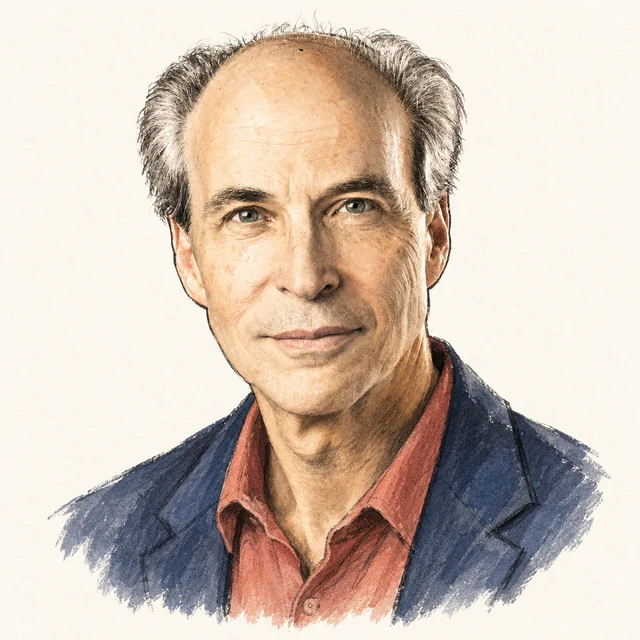
A life in context
The person behind the prize
Kornberg grew up in a family of biochemists. He studied chemistry at Harvard, completed a Stanford doctorate in chemical physics in 1972, and returned to Stanford in 1978 after research in Cambridge and at Harvard Medical School. His father Arthur received the 1959 medicine prize for a different subject involving nucleic-acid synthesis; Roger’s own work focused on how cells read genetic information.
The contribution
Kornberg’s studies revealed how transcription works in eukaryotes, organisms whose cells have nuclei. His group determined structures of yeast RNA polymerase II, including a complex with DNA and a growing RNA chain. He also helped identify Mediator, which connects regulatory signals to the transcription machinery. Together these results made the copying process understandable in molecular detail.
The idea in plain language
A cell does not normally use a chromosome directly as the template for making protein. It first transcribes selected information into RNA. In eukaryotic cells, RNA polymerase II makes the precursors of messenger RNAs. Kornberg studied this machinery in yeast, whose basic transcription process shares key features with our own.
Read the full award story ↗

