A life in context
The person behind the prize
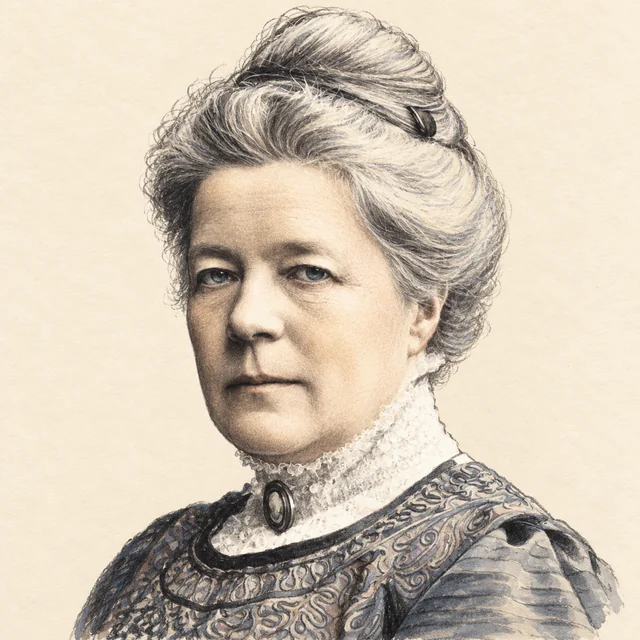
Selma Ottilia Lovisa Lagerlöf grew up at Mårbacka in Värmland, surrounded by family stories and local traditions. She trained as a teacher in Stockholm from 1881 and began teaching in Landskrona in 1885. A literary competition in 1890 brought excerpts of her writing to readers, and Gösta Berling’s Saga appeared in 1891. Its imaginative narrative met a mixed early reception before gaining wider recognition. In 1895 she left teaching to write full time. Travel with the writer Sophie Elkan took her through Europe and to Egypt and Palestine; those experiences informed the two parts of Jerusalem, published in 1901–1902. The Wonderful Adventures of Nils, published in 1906–1907 as a school reading and geography book, joined a journey through Sweden with fantasy. Her writing ranged beyond any one children’s story, exploring belief, community, responsibility and human vulnerability. She recovered the family home in 1907, before the Nobel Prize; prize money later helped her buy back the land and forest in 1910. In 1909 she became the first woman awarded the Literature Prize, and in 1914 the first woman elected to the Swedish Academy. She also supported women’s rights and participated in local public life and farming. She died at Mårbacka in 1940. The Nobel citation recognised her literary imagination and spiritual insight, rather than verifying the supernatural events narrated in her fiction.
The contribution
Lagerlöf received the full Literature Prize for writing marked by imaginative power, idealism and insight into inner life. Legends and landscapes could become ways of exploring the choices and ties that shape people’s lives.
The idea in plain language
Gösta Berling’s Saga joined the stories and people of Värmland with an expansive narrative imagination. Legendary and marvellous elements did not remove the human questions of dependence, love, guilt and responsibility. In Jerusalem, the pull of religious conviction and a journey away from home gave form to tensions between faith, community and attachment to the land.
Read the full award story ↗

